
This Tuesday I started back as a Teaching Assistant at the University of Waterloo on the undergraduate course ‘Sustainability: The Really Long View’, taught by Prof. Stephen Quilley. It’s the third time I have TA-ed this course and I love it! The course is designed to bring a sense of perspective on the problems we face today, not as way of reducing their significance, but as away of framing problems within broader relationships and wider perspectives.
This is a Big History approach, first defined by David Christian, which examines long time frames using a multidisciplinary approach based on combining numerous disciplines from science and the humanities. it is supported by the Big History Project website. Selected texts included Christian’s Maps of Time and Sapiens by Yuval Noah Harari
I teach tutorials, and our first one is focussed on Timelines. Students are asked to build 3 timelines and populate them with major developments; (1) from the Big Bang to the present; (ii) from 2 million years ago to the present and (3) from 1492 to the present.
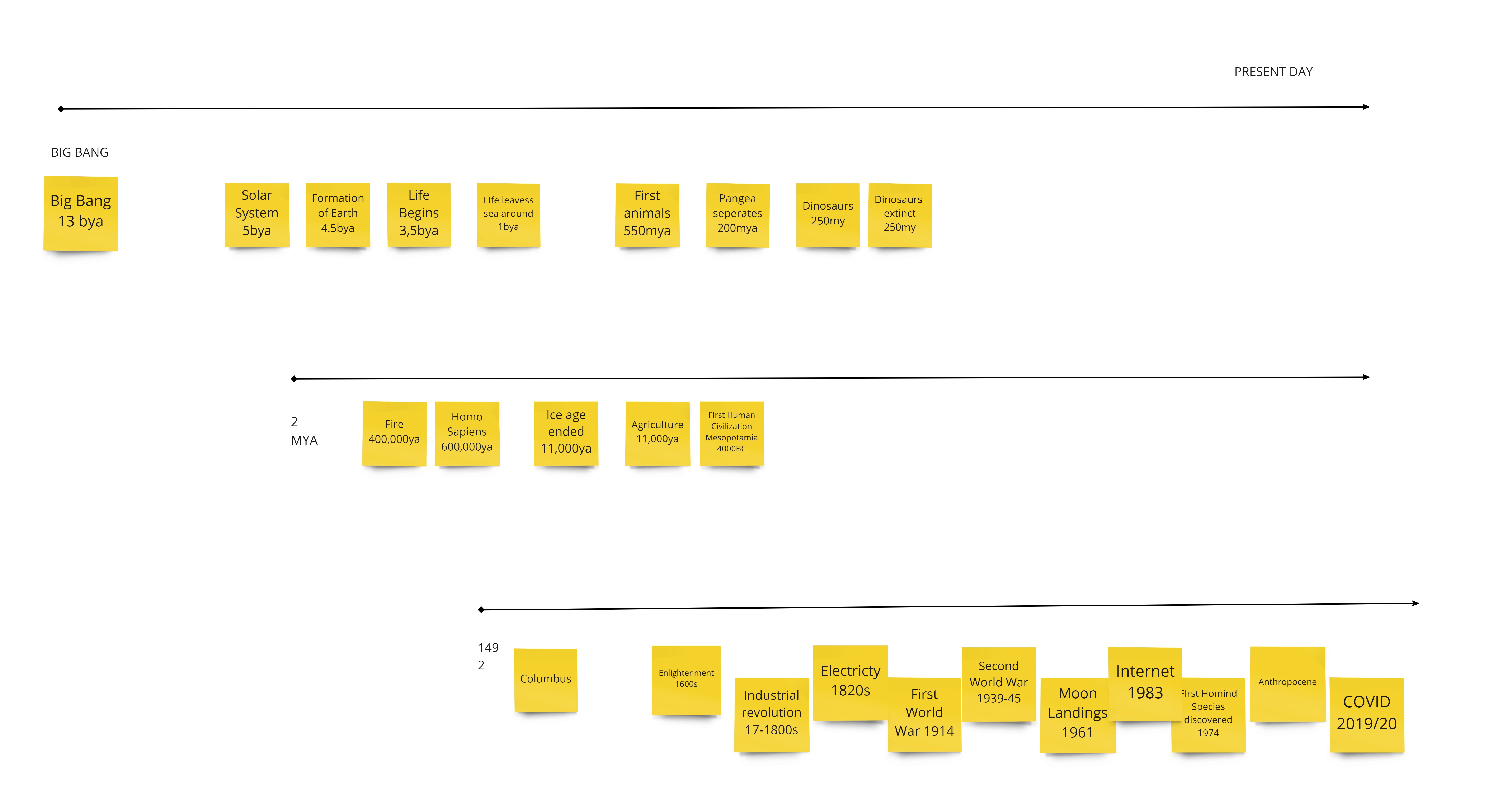
Students are asked to think about
- continuity (of what?) and rupture;
- the relationship between energy and complexity,
- the pace of change
- the difference between evolution and social development within the context of learning
- the context of fire, agriculture and industrialization
I invite you to do the same, and post your comments….
I am often surprised about how much and what I remember…and what I have forgotten. I wonder about the things I don’t know, and how this affects the narrative I hold about how the world is and how I act within it.
What if, for instance, I took as ‘fact’ another narrative about the origin of the universe that didn’t include the Big Bang?


 James T Jones
Leave a reply to Nicholas Cancel reply