
Sustainability: The Really Long View

This Tuesday I started back as a Teaching Assistant at the University of Waterloo on the undergraduate course ‘Sustainability: The Really Long View’, taught by Prof. Stephen Quilley. It’s the third time I have TA-ed this course and I love it! The course is designed to bring a sense of perspective on the problems we face today, not as way of reducing their significance, but as away of framing problems within broader relationships and wider perspectives.

This is a Big History approach, first defined by David Christian, which examines long time frames using a multidisciplinary approach based on combining numerous disciplines from science and the humanities. it is supported by the Big History Project website. Selected texts included Christian’s Maps of Time and Sapiens by Yuval Noah Harari

I teach tutorials, and our first one is focussed on Timelines. Students are asked to build 3 timelines and populate them with major developments; (1) from the Big Bang to the present; (ii) from 2 million years ago to the present and (3) from 1492 to the present.
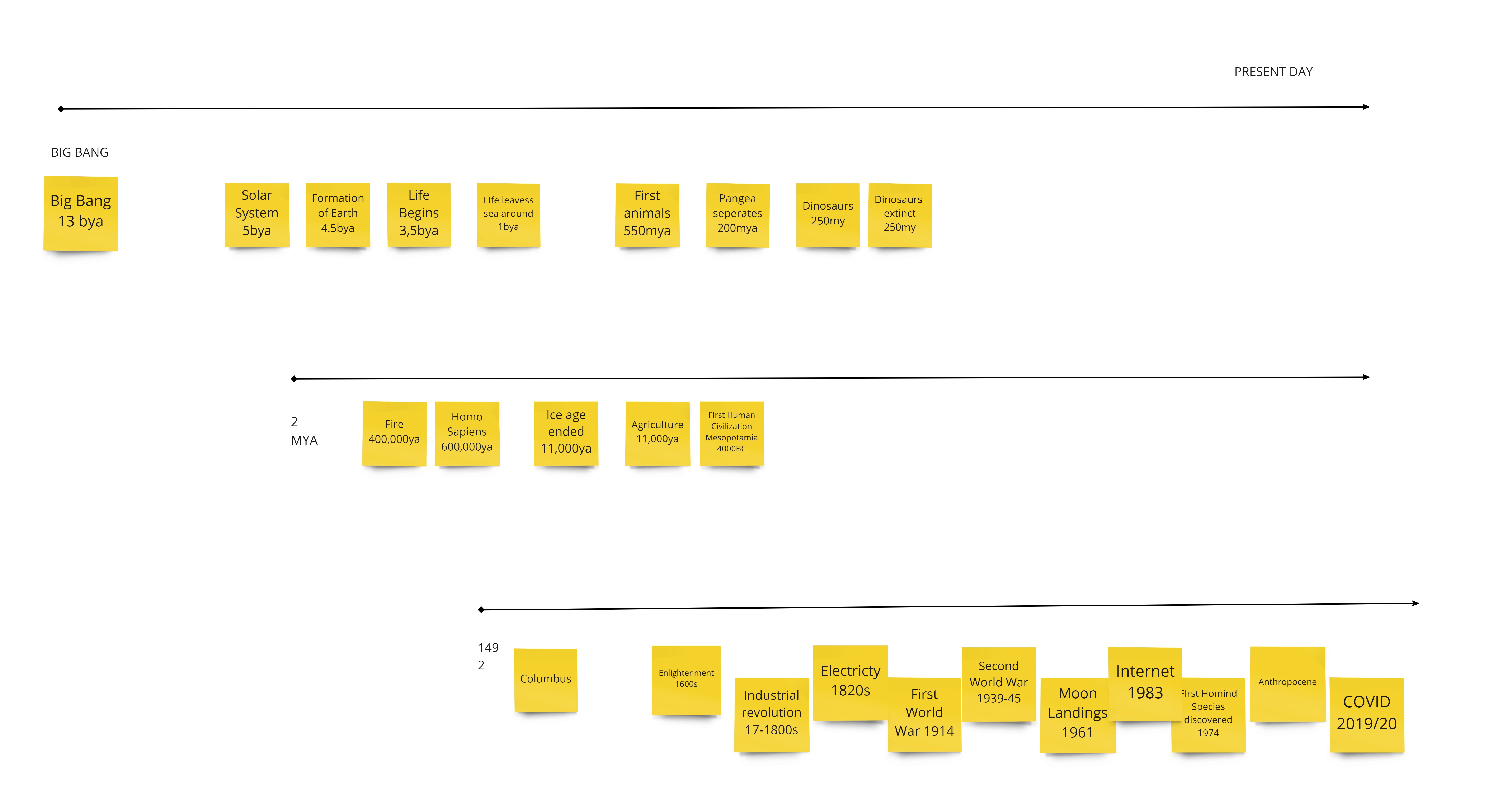
Above: Timelines output (15 mins brainstorm)

Students are asked to think about

  • continuity (of what?) and rupture;
  • the relationship between energy and complexity,
  • the pace of change
  • the difference between evolution and social development within the context of learning
  • the context of fire, agriculture and industrialization

I invite you to do the same, and post your comments….

I am often surprised about how much and what I remember…and what I have forgotten. I wonder about the things I don’t know, and how this affects the narrative I hold about how the world is and how I act within it.

What if, for instance, I took as ‘fact’ another narrative about the origin of the universe that didn’t include the Big Bang?

2 responses to “Sustainability: The Really Long View”

  1. Nicholas Avatar

    Hi Jim. I really like this kind of storytelling but am aware of some criticisms of it that bother me. One is the one you allude to in your last sentence. There’s another one, though, and I think you see it in some of the anger directed at Harari and Jared Diamond. I have been thinking about it because of some reading I’ve been doing (particularly Buscher & Fletchers ‘the Conservation Revolution’). The way I currently see it there’s a very widely held view that the story *has to* end with a call to political action. Therefore any story which isn’t at the scale where politics makes sense (humans and groups of humans having responsibility, taking decisions, being autonomous agents) is a bad story and should never be told. I really don’t like this criticism because I feel I can’t trust the stories I hear if they’ve all been edited to arrive at a particular conclusion. I wonder, though, if you’ve faced this kind of criticism on this course or considered it and how you deal with that.

    1. James T Jones Avatar

      Hi Nicholas! Thank you for taking the time to read my blog and for these thoughtful comments. I would expect nothing less from you! I agree with you that this approach to storytelling makes no sense, partly because I would argue stories at every scale are political. The foundations of social action are bound up in the way we perceive the world. Neurologist Iain McGilchrist (The Master and His Emissary) points out that “attention is a moral act: it creates, brings aspects of things into being, but in doing so makes others recede.” Philosopher Alistair Macintyre (After Virtue) argues that the foundations of our ontology and epistemology are the stories that surround us. Although I haven’t faced this criticism yet, but I’m also deeply suspicious of self-appointed gatekeepers of storytelling and those seeking to impose “new narratives” without consent. Its where I agree with Kingsnorth about environmentalism and conservation which seeks to impose its own normative narrative about the nature of our current crises.

      I’m also interested in the interplay between narratives at different scales and how they relate to each other. It reminds me of Buzz Hollings Adaptive Cycle/ Panarchy framework where there are connections between scales. Storytelling at its most basic starts locally as an emergent property, a co-created sensemaking which is particular to context. But narratives scale up to become Grand Narratives that are intrinsically fragile, because they require a broad consensus of support- lots of wheels all spinning in the same direction.

      Lets talk more!

Leave a comment