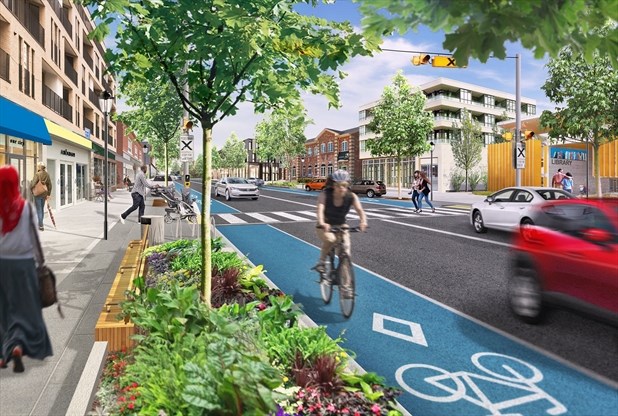

Last Wednesday I attended a Greenbelt Foundation Workshop on Creating Complete Communities in Rural Municipalities at Gellert Community Centre in Halton Hills.
As an independent researcher, I’m collaborating with Waterloo and Queens Universities, Save The Oak Ridges Moraine (STORM) Coalition and Mount Wolfe Farm in the development of the Oak Ridges Institute of Applied Sustainabiity (ORIAS) . This will be ‘clearing house’ for research and action on sustainability issues in the Greenbelt, using a complexity and systems thinking lens to solve problems and direct action. Today would be an opportunity for me to improve my knowledge on issues facing rural communities.
‘Complete communities’ offer a full range of jobs, retail and services, housing options, transportation options, and public service facilities. The Garden City Movement was one of the first proponents for creating communities that accommodate a wide range of community members through a mix in housing types and uses. Increasing urban sprawl, and its associated negative social, environmental, and health effects, prompted a turn in theory towards increasing density in urban areas. This idea has been brought into contemporary theoretical movements including Smart Growth, New Urbanism, and Sustainable Development, which all advocate high-density ‘compact’ communities, and also increase the mix of activities and land uses that contribute to a complete community.
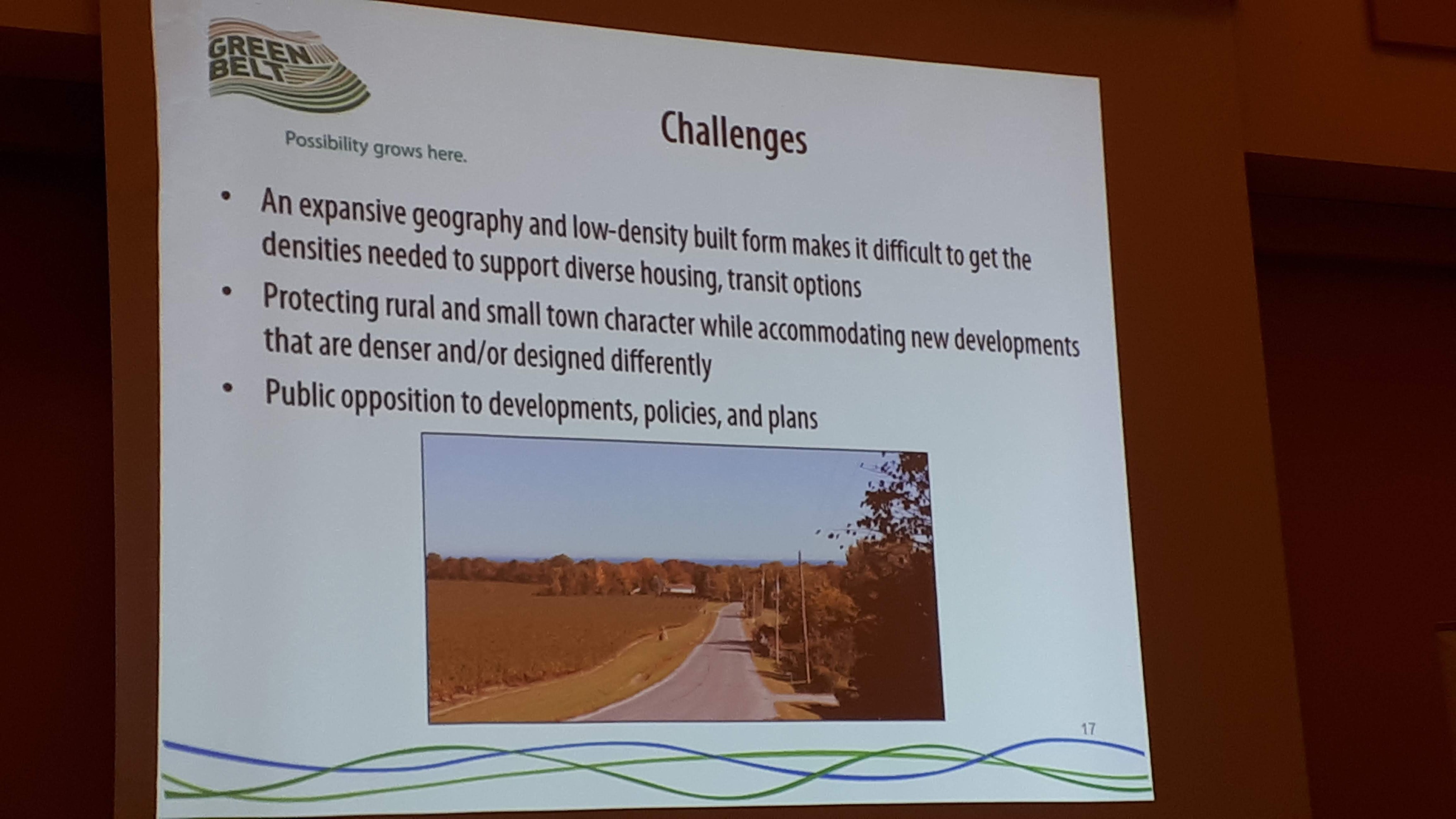
While supporting the development of complete communities in all settlement areas is a core objective of Provincial policies, small and rural communities can face difficulties with implementing the complete community concept in their unique context.
Today was an opportunity to hear about what rural municipalities in and around the Greenbelt are doing to support more diverse housing options, transportation modes, local jobs, and revitalized downtowns to create healthier, more sustainable, and complete communities.
The workshop started with a review of current work by Anna Shortly, Reesarch and Policy Analyst at the Greenbelt Foundation on her review of Rural Municpal Initiatives to create Complete Communites which will report next year. Municipalities are working to:
- -directing growth to areas with infrastucturee (e.g King City Go Station)
- -using focal points or nodes with a concentration of services eg Waterdown Community Node, and adopting policies to identify ‘nodes
- -promoting diversification of housing types e.g -appartments & condos
- -using vacant under-utilized/ lots
- creating Community Improvement Plans CIPs)- e.g Bolton CIP with financial support support
- Policies to promote Walking & Cycling and Public transit
- Looking to create local Jobs!
- Investing in historic, downtown & waterfronts
- Creating valuing-added agricultural opportunities
- Recreational tourism
- DOWNTOWN revitalisation
- Multi-Use Trails

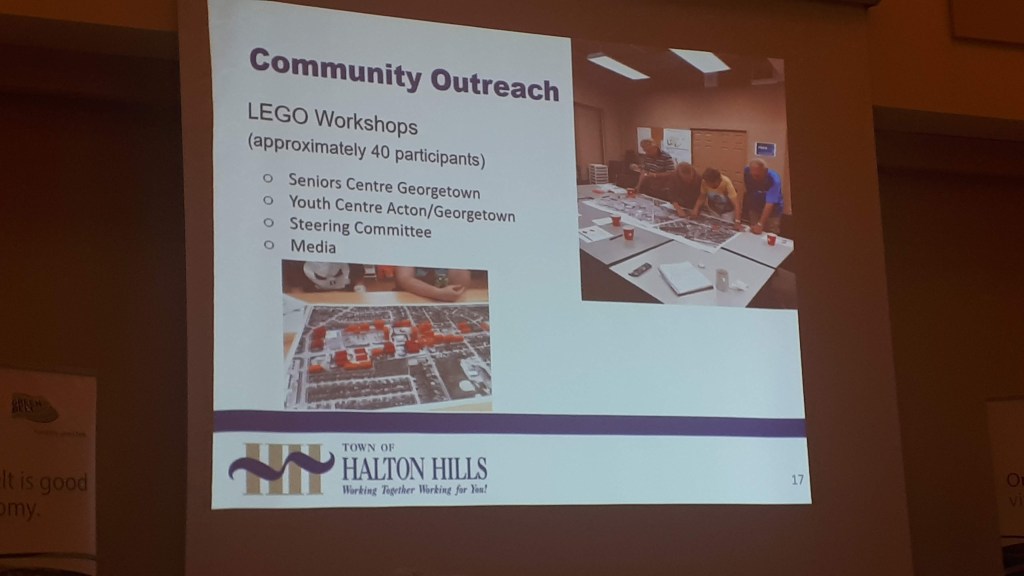
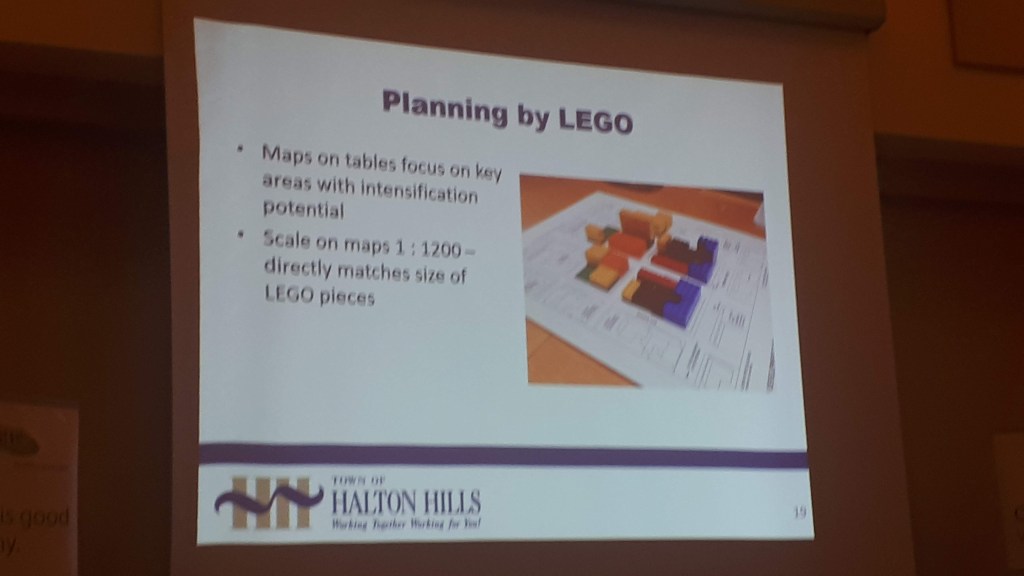
We then heard from Melissa Ricci, Senior Policy Planner at Halton Hills on an intensification opportunity in Acton with some innovative use of Lego bricks and visualisations!

Michael Benner Directer of Planning and Building Services from the Grey Highlands gave as a fascinating overview of work to revitalise Markdale- the home of Chapman’s Ice Cream. The problems here are two fold, despite the ice cream firm being a big employer most of these are not locals. There is growing development pressure in this area where the main buyers are either (i) older people looking towards retirement or (ii) people who can work from home using teleconferencing facilities. Town Units are selling for $500K+, which is very likely outside the range of people with local jobs. But the attraction of building new homes is easy to see: $9 million in one time development charge revenue and $3m annual tax revenue, plus a new school and hospital. Grey Highlands is working to put this development in the right place, looking at local cores and main street and has even purchased property in the Downtown Markdale area for a multi use retail/ offices and private dwellings.
One aspect i found very interesting living here at Mount Wolf Farm is allowing a diversification of on-farm uses. There has been a rise in the number of machine shops on farms, particularly in the Mennonite community, adding to local employment and the rural economy.
The last speaker in the morning was Vicky van Ravenswaay from Pelham who spoke about community efforts amounting to a claiming back of the streets of Pelham for people. Focusing on the concept of Applied Walkability and Place-Making. Movements to redesign roads and pavements to make them more accessible to walkers- even through the wintert. In Pelham, Thursday nights are now market nights with street closures giving the streets back to the community.
The town also erected a series of Arches which at first looked like the entrance to McDonalds gone mad, but I found it interesting that after an accident that caused their removal they are now reinstated with colour themes and decorations at different times of the year. The concept of having a landmark or symbol can be a powerful place-maker (marker?) and – love it or hate it- can add an identity to a town .
Key lessons from Vicky: Don’t be affaid to close streets; Support, empower local groups; Start small & grow; Must have support of your leadership
A clear message was “if you have to put up street signs to say slow down you have designed the street wrong!”
The afternoons discussions were held in focus groups around these themes:
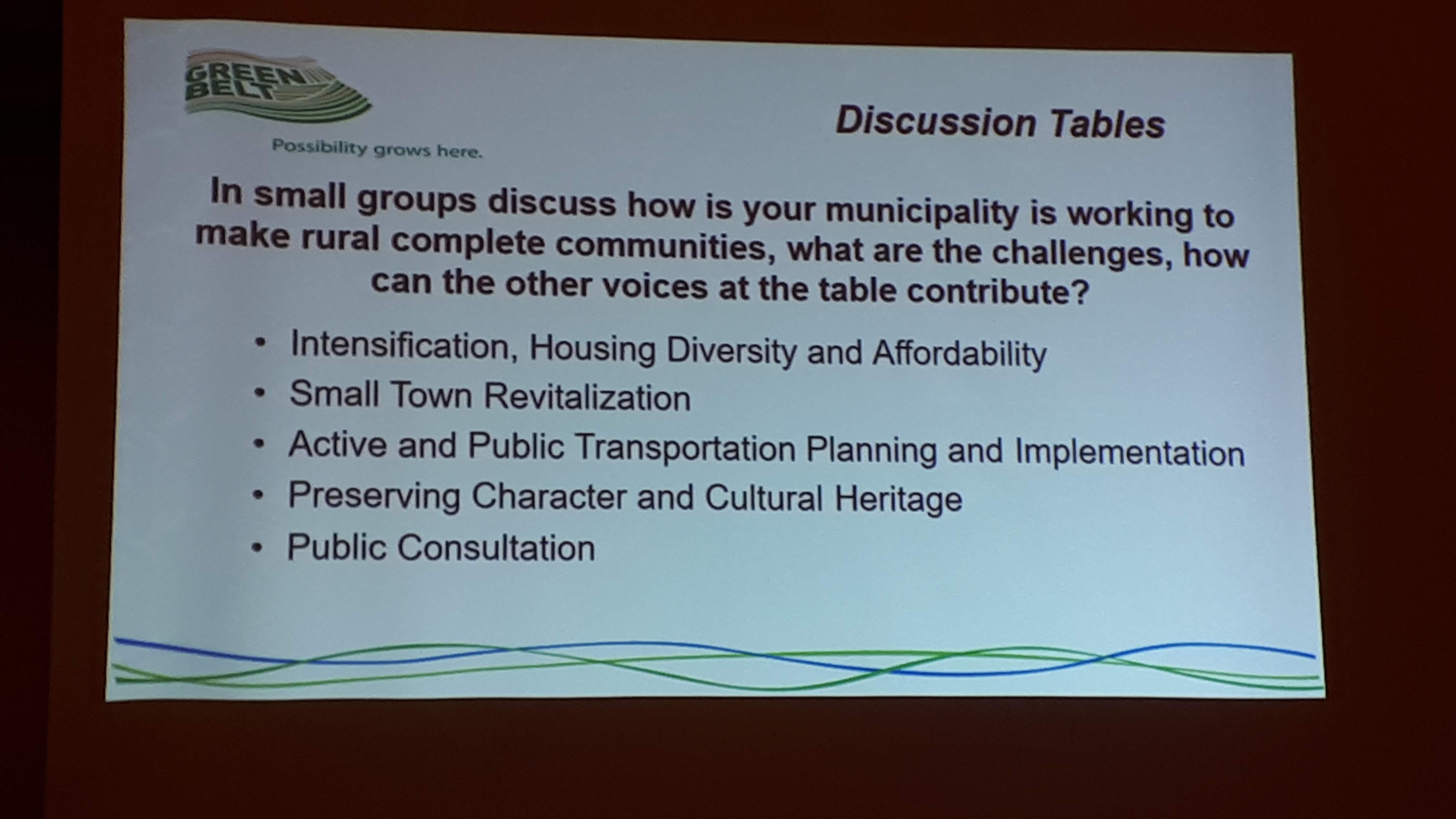
I joined in with Public Consultation and Small Town Revitalization discussions. My takeaways were:
Public Consultation
Public consultation should be a partnership. It should aim to get to the heart of local stories and develop visions in a participatory journey
Generally this comes too little, too late. If you are afraid of what the public might say and you aren’t prepared to give up control over the outcome, then consultation just becomes a box ticking exercise. At the point most of the respondents will be making a knee-jerk reaction in fear over loss of THEIR control.
Small Town Revitalisation
Our session started with a serious concern about the maximum number of people that a community can support before it loses its character as a small town, which prompted the group to think about what makes a small/ rural town what it is and consider that this might be a moving target as expectations change from generation to generation. Are we perhaps suffering from shifting baseline syndrome. A conversation around public consultations emerged, with the agreement that this happens too late in the path to development so towns suffer from death by 1000 cuts rather than any serious efforts to focus on long-term planning. In the context of sustainability, focusing on local jobs, affordable housing and reducing dependence on the car/ increasing active transport were thought to be good mechanisms for revitalisation.
I found this a very valuable workshop with my key takeaway thoughts for creating Complete Communities:
- Make people part of the planning process at the beginning and define review processes.
- Explain the role of risk, uncertainty and complexity especially with reference to climate change
- Focus on local livelihoods and active transport/ transit where possible
- Don’t underestimate the power of place-making in creating communities

 James T Jones
Leave a reply to hilary neilson Cancel reply