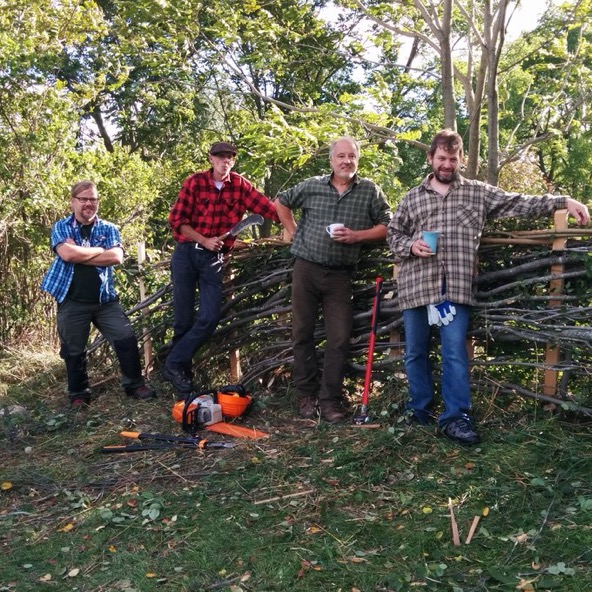
Where I find myself in Ontario Canada introducing the technique of hedge-laying and discovering social-ecological complexity, Novel Ecosystems theory and Community Supported Agriculture along the way
I’m writing this blog as US Citizens go to the polls and a baked potato crisps in the oven, getting ready for a date with home-made chilli. By the time you read this, we will have a new ‘leader of the free world’. I doubt much will change really, except the aforesaid citizens will have as much to divide them as we Brits now have thanks to Brexit
So if you can’t bare another Trump vs Clinton, Brexit vs Remain story, let’s talk about Connections, my favourite topic. There is after all far more that unifies us than divides us.
I was invited as a guest of the Institute of Social Innovation and Resilience at the University of Waterloo, Ontario, to take part in exploring social-ecological complexity, and in particular the role hedgerows and hedge-laying might play in designing “novel” or “designer” ecosystems ahead of the inevitable growth of the Toronto Golden Horseshoe.
Hedgelaying in Ontarios Greenbelt-Program Fall 2016
I’ll explore the detail of the project in a later blog, but for now it’s worth explaining how this invitation came about due to its almost serendipitous levels of connectivity. Before I joined the Surrey Wildlife Trust I ran a project for the People’s Trust for Endangered Species called Hedgerows for Dormice (HfD) (HfD Newsletter 2011) from 2009-12, for which I ran a series of workshops across England and Wales for Landowners about Hedgerow Management. Through this project I had joined Hedgelink which at the time was the UK BAP for Hedgerows Steering Group, and now goes from strength to strength as a technical advisory group on hedgerows which are a Habitat of Principal Importance for Nature Conservation in England.
Through Hedgelink I met Nigel Adams, a countryside management professional specialising in hedge-laying, and vice-chair of the National Hedgelaying Society. I enlisted Nigel to help me with the HfD Hedgerow Management Workshop, providing a much-needed practical element of hedge management through his 10-point plan to compliment the positive wildlife message from my PTES project. Nigel also attended my NERC Workshop on Hedgerow Connectivity at Imperial College in 2014 and off the back of this he enlisted me in the 3-man mission (with Jef Gielen, a hedge-layer from the Netherlands) to Ontario to demonstrate the art of Hedge-laying. Nigel and the NHS had hosted the Waterloo team, headed up by Dr Steve Quilley and PhD Candidate Perin Ruttonsha, when they attended the National Hedgelaying Championships in 2015, and who subsequently invited him and Jef to take part in the all program at Waterloo in 2016.
Nigel, Jef and I were intrigued by the invitation because we didn’t equate Canada with hedgerows, let alone hedgelaying. The team at Waterloo were tasked with finding a hedge for Nigel and Jef to demonstrate their art and it soon became clear that finding a suitable “hedge” was not easy. After arriving in Ontario on a Monday evening in September we went straight to work on Tuesday demonstrating hedge-laying on a small patch of shrubs at the Quilley’s property in Elora. I say “we” I am of course more an eager conservation hedge-layer rather than professional like my colleagues but the “hedge”, layed midland style, was soon shaping up. Until we ran out of shrubs to lay!
Following this first demonstration we journeyed with our hosts from our base in Waterloo to Caledon and scoured Mount Wolfe Forest Farm for a suitable hedge to lay. Beautiful as the farm is, it did lack anything resembling a hedgerow although a line of trees along the edge of a woodland strip gave us the opportunity to demonstrate again. Assembled at Mount Wolfe to watch the demonstration were some of the posse that had been to the 2015 Hedge-laying Championships in the UK including Debbe Day Crandall (Save The Oak Ridges Moraine Coalition), Gord Macpherson (Toronto Region Conservation Authority), Karen Hutchinson (Caledon Countryside Alliance/ Albion Hills Community Farm) and Nicola Ross (Writer and Environmentalist), together with farm manager Sarah Dolamore, all keen to see how hedges and hedge-laying might be a useful tool in the conservation of the Oak Ridges Moraine Area.


These hedge-laying demonstrations naturally gave rise to many questions. Why aren’t hedges, never mind hedge-laying, more prevalent in Ontario? What are the best species of shrub to use from the palette of Ontario species? In our hedgerows were maples, ash, basswood, hawthorn and buckthorn which all seemed to work but would this yield the best results? How might snowfall impact the newly cut pleacher? There may be good practical reasons why hedges haven’t been planted extensively in Ontario, however further work should look to map current hedgerow extent. Nigel and Jef had brought their own bilhooks over with them thinking no such equipment would be easily available. Only after they had both left (I stayed on for two extra weeks) was a Canadian-made billhook unearthed in the Barn at Mount Wolf Forest Farm


Of course there may also be social aspects to explain the lack of hedges. Settlers from Europe were in some cases disenfranchised by the theft of common land and its redistribution to wealthy landowners exemplified by the exclosure acts. During the enclosure acts of 1750-1850 over 200,000miles of hedgerow was planted enclosing over 2 million acres of land. Perhaps hedgerows represented a way of life settlers would rather forget. I will come back to this because I think it raises some challenging questions about how much social and cultural aspects should be considered when ecosystem functioning is threatened.
The general consensus was that some trial hedges should be planted as soon as possible to answer some of these practical questions before hedgerows might be rolled out as a component of green infrastructure.
Subsequent blogs will explore:
- Novel ecosystems concepts
- Complexity and resilience
- Ontario-Surrey Comparisons
- Community Supported Agriculture & Forestry
- Locally-derived ecological coherence & resilience
Oh, and here are the donuts………


 James T Jones
Leave a reply to Maasheggenvlechten: Hedge Weaving in the Netherlands | Web of Life Cancel reply