This Earth Day let’s look deeper at the problems behind the problems in our world. What would it mean for us to begin a discussion about changing the way we perceive the world and how we act in it?
This Earth Day, ask yourself what’s the story you have about the Earth? What is your relationship to it. If you like, with your family or a group of friends, try the story circle activity after the blog.

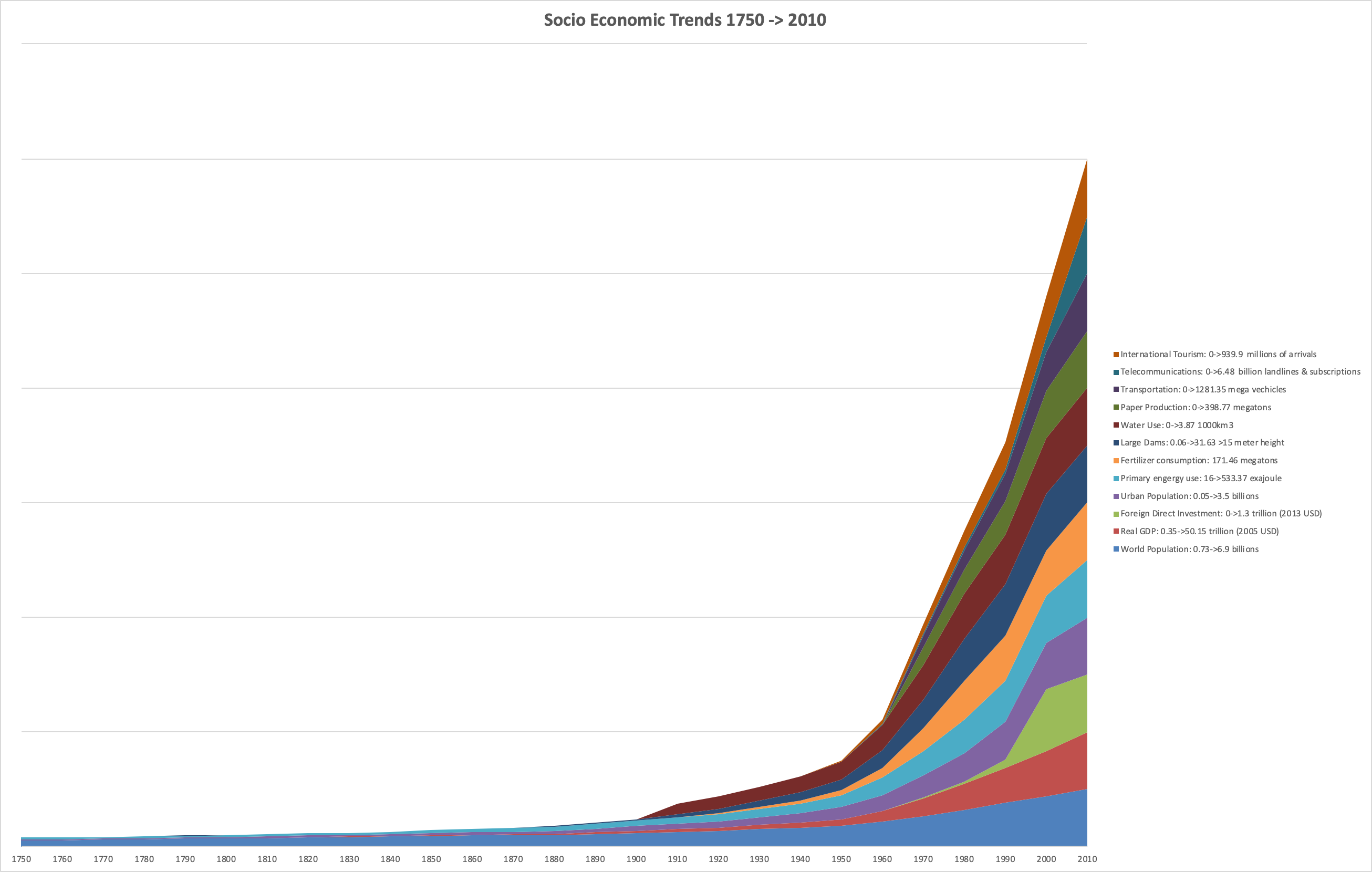
We are in the midst of the Great Acceleration, the rapid and accelerating growth in a number of physical and social indicators which in the context of the Anthropocene are measures of humanity’s collective impact on the Earth.

We have known there are physical and social limits to growth for at least 50 years. In the 1970s, MIT scientists predicted Limits to Growth and their models have been proved largely on track.
“If the present growth trends in world population, industrialization, pollution, food production, and resource depletion continue unchanged, the limits to growth on this planet will be reached sometime within the next one hundred years. The most probable result will be a rather sudden and uncontrollable decline in both population and industrial capacity.”
Meadows et al (1972) Limits to Growth
On Earth Day, getting used to the idea of some kind of limits on human activity is a really important. Recently in her book Doughnut Economics, economist Kate Raworth showed that there is a just and safe space for humanity between environmental limits and a social foundation. For instance, we need to meet limits of CO2 output to prevent climate change, but work for limits to inequality in access to food and education.

Global effort to achieve Limits to Growth is toward meeting 17 Sustainable Development Goals by 2030, a deadline which are not likely to be met partly because the system its relying on to solve the problems-economic growth- is the system that’s causing the problem.
In a recent webinar series called When Meaning Loses its Meaning, Nora Bateson and Dave Snowdon propose that the way we create meaning in our world is at the heart of the problem. We see our existence as if it were a wrist watch- we know the parts, we how they connect together, so we know the whole. The parts and the processes that connect them are controllable. Yet in reality, the relationships of the parts to each other and to the whole are changing all the time. So when we look at the problem of sustainability, reducing it to its parts doesn’t solve the problem. In the second webinar, “Pulling the Jenga”, Dave and Nora use the Jenga metaphor to talk about the deeper fundamental problems of perception which keeps us trapped and making the same mistakes.
The idea that the way we perceive and work with the world is at the heart of our inability to really fix problems- to see the problem beneath the problem-has emerged in the last century through developments in systems science and complexity to what Capra and Luisi describe as the a Systems View of Life. Our current crises is largely due to the dominance of the mechanistic and reductive philosophy and science gifted to us by Bacon, Descartes and Newton in the Enlightenment of the 17th-18th Century. This was a pendulum swing away from the holistic visions of the early greek philosophers and scholasticism of the middle ages where parts where what they were because of their relationship to a larger whole. Plato and Aristotle this was the Anima Mundi or world soul and the relationship between the Macrocosm and Microcosm. For Aquinas in the middle ages, drawing on the earlier works of Aristotle, God was the whole that structured the physical and social worlds. Morris Berman in the Reenchantment of The World also describes this triumph of reductionism. More recently the neuroscientist Iain McGilchrist in The Master and his Emissary describes how a differences in attention between the brain’s left and right hemisphere may have set up this cognitive imbalance between holism and reductionism. The left brain h attends to focus- the right to everything else, including making sense of the focussed attention from the left hemisphere.
To be clear, none of these authors suggest the scientific method or a reductionist approach is wrong, but rather they shouldn’t be the exclusive methods that we make sense of and act in the world to the extent that they now dominate our Modern/ “Western’ /Global North cultures. What is also of huge significance is the confluence of scientific thinking in systems and complexity with the holistic world views of many indigenous peoples emphasised by indigenous scientists like Tyson Yunkaporta in his book Sand Talk.
So this Earth Day lets look deeper at the problems behind the problems in our world. What would it mean for us to begin a discussion about changing the way we perceive the world and how we act in it? Is it possible that we can move towards an Earth Day Every Day, where the Earth recaptures its place of wholeness and unity at the centre of our disconnected lives.
STORY CIRCLE ACTIVITY:
Share stories about your relationship with the Earth with your family and friends
- Each person takes a turn telling the story while others listen.
- Listeners right down on pieces of paper or post-it notes what thoughts, feelings and ideas emerge from each of the stories.
- When all of the participants have told their stories, look at the written responses and try to look of for relationships and patterns. If you like you can group them and label the groups.
- What do the patterns and /or categories tell you about your collective stories? What surprised you? Where were the differences and could you explain them?
- How will you shared stories guide you in your relationship with the Earth?
 James T Jones
Leave a comment