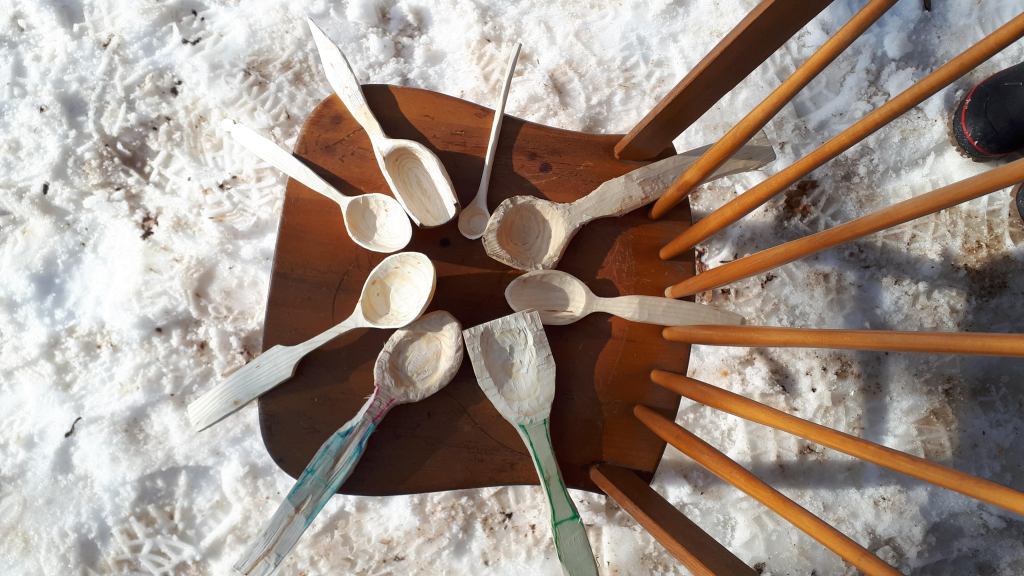


We’ve had regularly good class sizes (5-6 people) for the four spoon carving workshops I have delivered here as part of the Ontario Rural Skills Network and interest doesn’t seem to be abating. SpoonfestUK in August 2019 is sold out as well. I cannot keep up with the number of wonderful ‘Spoon People’ out there through social media. A simple web search to try to get to the bottom of the popularity of spooncarving finds a growth in the number of books published on or related to spooncarving in recent years

It’s part of what seems like growing interest – a revival if you like- in skills and crafts-based learning. Is it a ‘hipster fad’ as The Times newspaper suggested. Or is it something deeper, an attempt to enrich our lives as The Independent reported Interestingly, but not surprisingly, both these newspaper articles appear in 2017 at the peak of the book-publishing.
My own view is that this revival of skills and crafts is a reaching out by people for something deeper and more connected. Making stuff is a central part of the human evolutionary history, and until recently making involved the whole of our bodies. The creative spark of innovation in our brains was intimately connected with the mechanism of making the vision a reality which involved posture, energy, muscle power and memory and something else, the flow between postures when working which makes practical working something akin to tai-chi or yoga
Perhaps this return to learn these skills is for many of us in more sedentary occupations- and probably more affluent lifestyles-a desire to reconnect our bodies with our minds in the work we do. Of course its important to remember that spoon carving is an introduction to working with wood and tools which may seem a luxury to some but has a serious purpose. In the last few months we have seen global protests build over Climate Breakdown and just this week a report from the UN IPBES documenting the massive declines in biodiversity with gloomy predictions for the extinction of a million species. Our societies appear to be struggling to come to terms with their own complexities, built thanks to the availability of cheap fossil fuels. The message is clear: anywhere we can reduce our dependencies on carbon-based energy, we must act to do so.
What part might spoon carving, rural skills and crafts have in transitioning us to low-energy ways of living. Well clearly we try not to use any power tools in spoon-carving- or at least use them sparingly! As has pointed out by researchers at the University of Surrey, when engaged in’ flow’ activities which may include spoon carving, its time spent not consuming (Isham et al 2018). Carving can be done alone, but it is best undertaken socially where ideas can be shared mutual support can be given and stories can be shared.
While spoon carving wont save the world, it might act as ‘gateway drug’ to the adoption of more pro-environmental behaviours. In a recent study by Elf et al 2019, evidence for a ‘spillover effect’ from small ‘environmentally-friendly’ behaviours (switch off lights, avoid food waste) into wider pro-environmental behaviour. Interestingly the authors found a strong influence from group dynamics in their study.
As part of the Ontario Rural Skills Network we are asking workshop attendees to fill in pre- and post- workshop questionnaires to assess attitudes to a range of environmental questions and whether our workshops help in bringing a wider understanding of the need to transition to sustainable lifestyles, and what role the workshops might play in motivating people to act and adopt a wider pro-environmental identity. As a project of the Waterloo Institute of Social Innovation and Resilience (WISIR), and with our partner the Save The Oak Ridges Moraine (STORM) Coalition we hope to also explore what role these skills workshops might play in advocacy for sustainable landscapes.

 James T Jones
Leave a reply to Crafting Sustainability: Counter-culture Movements and Sustainable Development Goals | Web of Life Cancel reply