Happy Earth Day! Despite my best intentions for a monthly long blog this is only my second of 2023!
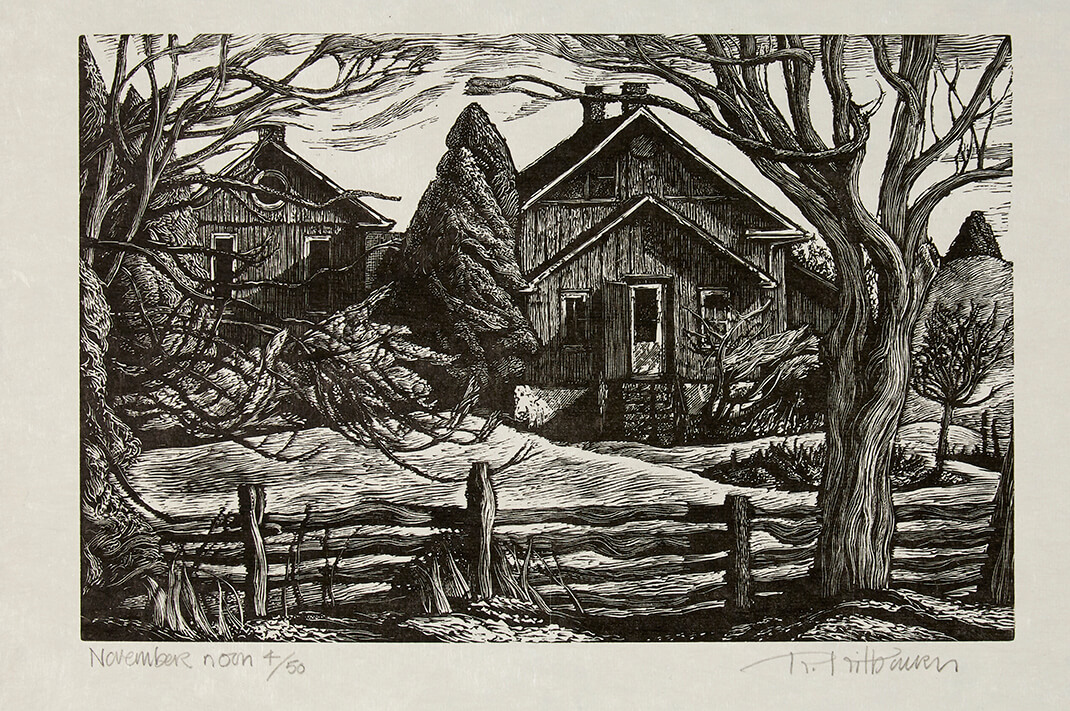
November Noon 1984
wood engraving on paper ed. 4/50, Promised gift, 2018
from Art Gallery of Hamilton exhibition Rosemary Kilbourn: A SIngular Place
This wasn’t intended as an Earth Day blog, but its seems apt to be publishing this today as a story about connection to place, love of natural landscape through art and community, and renewal. I have been one of the Friends Of The Dingle Schoolhouse since 2019 and facilitated a narrative sensemaking session for the team in 2020. The story of Rosemary Kilbourn, the Dingle Schoolhouse and its Friends is rich with history, family, community and perhaps above all this connection to place. For the work I do supporting community decision-making using story, it is also a case study of how narratives can help make sense of complexity and reveal unexpected possibilities.
This is a story with themes of place, community, identity, legacy, imagination and shifting perspectives. I’m a recent (2018) settler from England, and much to my amusement, I found myself moving from one area of rolling hills forty minutes outside a sprawling metropolis to another! I left my home in Dorking, a small town in the North Downs, South of London, surrounded by farmland on a chalk escarpment cloaked with oak and beech woods. I now live at Mount Wolfe Farm in Caledon amongst oaks and maples on the glacial deposits of the Oak Ridges Moraine. Unfortunately, the ever-present threat of development is common to both areas as nearby urban centres spread relentlessly, consuming farmland and natural landscape areas.
If a story can find its own beginnings, this one begins with a schoolhouse in a remote part of the beautiful Caledon Hills in a valley formed by an eroding glacier between the Niagara Escarpment and the Oak Ridges Moraine in Southern Ontario. This land has been part of the traditional territories of the Haudenosaunee, Anishinaabe, and Petun peoples, and most recently, Mississaugas of the Credit First Nation (Treaty 19). In 1821 Lot 35 Concession 1 was granted to Loyalist Jacob Rawn for services to the British Government during the Wars of Independence and 1812. In the 1830s a log-built schoolhouse was established but replaced with the current brick structure in 1872. The Dingle Schoolhouse and its grounds are now part of the Glen Haffy Conservation Area under the ownership of the Toronto Region Conservation Authority.
The Schoolhouse was, until very recently, the home and studio of painter, engraver, and stained-glass artist Rosemary Kilbourn who moved there in 1957, and from where she produced some of Canada’s finest art. The location became an inspirational space for Rosemary’s guests which included Barbara Howard, poets Richard Outram and Luke Hathaway, and artists Will Ogilvie, Frances Gage, Pauline Hooton (Hall), and Yvonne Williams. In an article in the Caledon Citizen in 20191, Hathaway expressed perfectly the genuis loci of the Dingle and how its personality has found a way into the wider world through Rosemary and the other artists who have lived and worked there.
“.. it’s a place in the deepest sense of the word. This place sort of furnished the matrix of the world divine, that is reflected and refracted in the work. So[in that sense] the Dingle has gone out into the world.”
For my first visit to the Dingle Schoolhouse in October of 2019, out of curiosity, I was drawn to accompany Mount Wolfe Farm’s Crandall sisters to a meeting with Rosemary’s niece Pippa Kilbourn and close family friends Zoe Lepiano (also curator of Rosemary’s work) and her mother Jenifer Sutherland. It was a meeting to discuss possibilities to fulfil Rosemary’s vision for the schoolhouse as an artists’ studio and residence. In the Crandall family lay a wealth of local knowledge: in particular Sarah Crandall Haney as Director of Caledon Heritage Foundation and Debbe Crandall in planning and conservation through the Save The Oak Ridges Moraine Coalition. I thought my own experience in conservation and ecology, and working with community groups, might also come in useful but really I was mostly fascinated by the story of Rosemary and the Dingle.
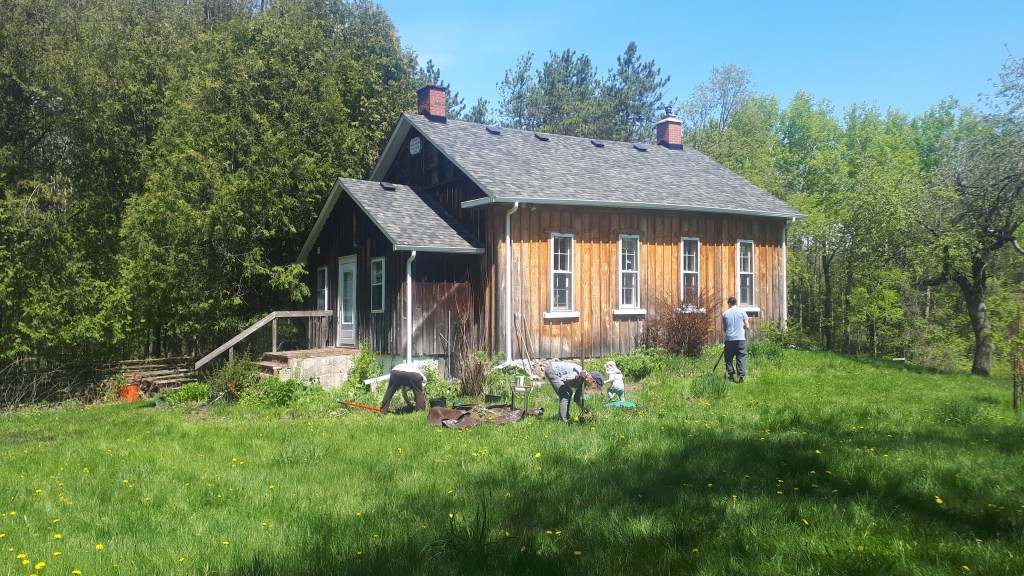
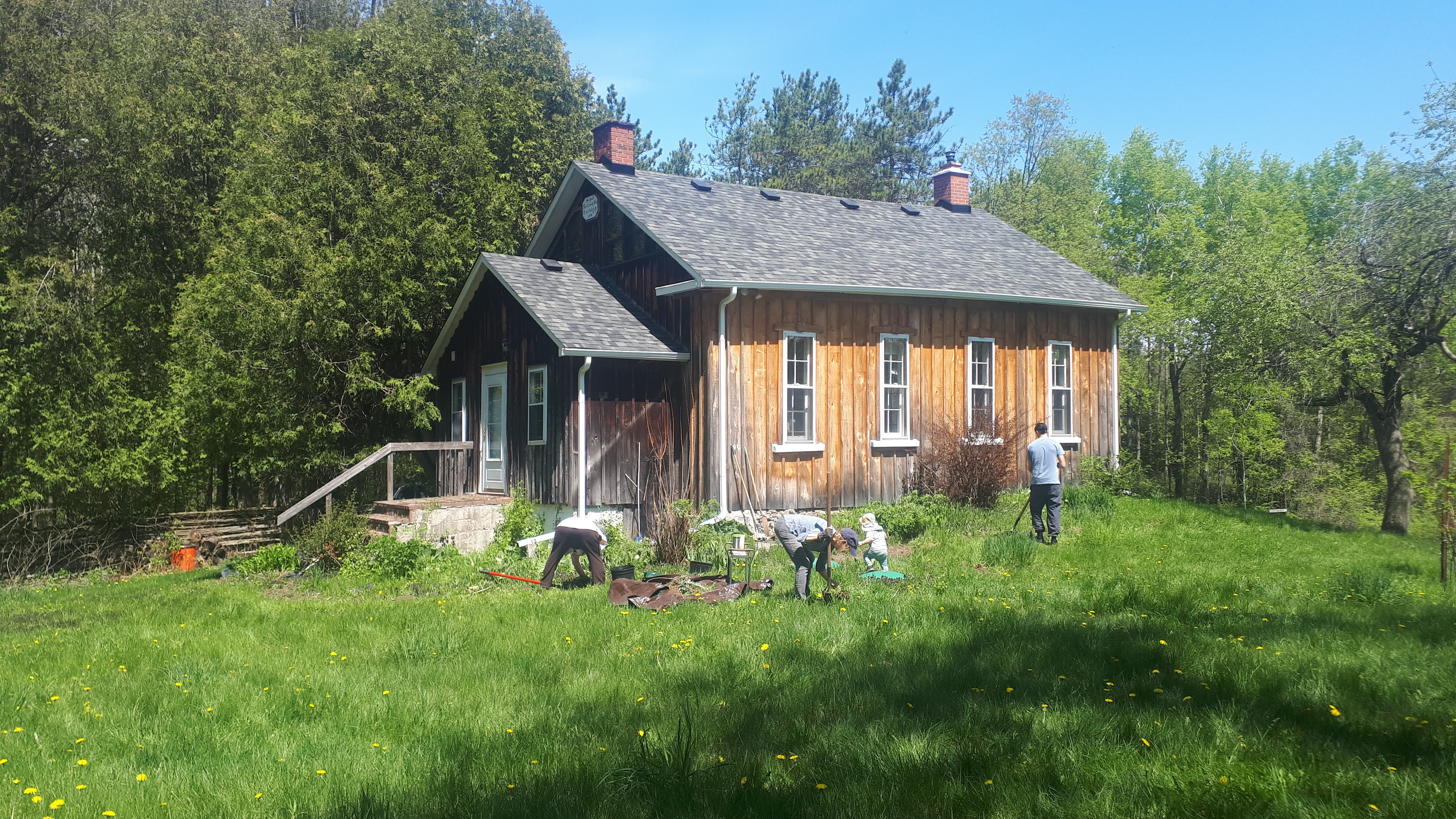
The approach to the Dingle Schoolhouse is a moment of mythical transition, a crossing of a barrier between worlds, as I suspect Rosemary knew when she first saw it 1957. We drove in through a locked barrier on a tarmacked access road towards the Glen Haffy fishing ponds. As we drove, I felt the beat of my heart, and of time, slow. The dense woodland on either side made me feel observed, inspected almost. The track wound up and up, over the Dam that was to play a large role in the story, to a sunny slope of the Niagara escarpment. The Schoolhouse sat on one side of a clearing in the woods surrounded by overgrown flower beds, its once-bright Board-and-baton exterior darkened and faded, a patchwork of orange-brown-grey, white-trimmed at the windows, fascia boards and guttering. A second building, Rosemary’s studio, sat companionably adjacent. Moving around the building, an unkempt but not unloved meadow stretched out to overhanging old maples at the edge of the forest to the North; in front of the house was a fenced-off garden plot in need of some TLC. Downslope from the house sat a small pond and in the near distance, a striking tumulus reminded me of Silbury Hill in the Stonehenge Landscape. We moved inside into a homely living room, a fire in the stove. Before our conversation, we took a tour of the schoolroom and gallery. I don’t recall details of the day, but rather a feeling of peace, tranquillity and….possibility. This place, inside and out, positively oozed creativity from every wooden beam and pane of glass.
The Vision
In 1988 Rosemary sold the Dingle and lands to the TRCA with an agreement that she could live there and manage the property until such a time as she was no longer able. She moved out in 2019 into assisted living after 62 years, but under the terms of the contract no longer had any say in the future of the property. However, Rosemary had a vision that the Schoolhouse would be used as an artist’s studio and residence in the future. Rosemary’s vision was shared by many and in 2019 a committee was formed to call on the TRCA to preserve the property as a cultural heritage site and have it serve as an artist space and residency. The committee which became the Friends of The Dingle Schoolhouse included Kilbourn’s niece and nephew, Phillipa and Timothy Kilbourn; family friends Jenifer Sutherland and her children Zoe and Leo Lepiano; Luke Hathaway and the Crandall Sisters.
While I joined the Friends out of curiosity it soon became obvious that my particular skillset in participatory sensemaking would be useful to the group as it sought to map the opportunities and constraints which defined this moment and to set out a roadmap to achieve Rosemary’s vision. In December 2020 as the Pandemic raged through the land, when assembling at the schoolhouse was unwise, the committee convened online for a Participatory Narrative Inquiry (PNI) Workshop.
Working with Stories
PNI is based on action research and was developed by the PNI Institute. It’s all in the name: PNI is participatory, with everyone engaged; narrative, creating and exploring stories and their form; and inquiry-led, where the group makes sense of outputs themselves without direction.
Communication scholar Walter Fisher argued that all humans are storytellers and that culture is a collection of key stories and narratives. Research in organisational management has found narrative sensemaking is a powerful tool for working with complex situations marked by feedback loops, uncertainty and surprise.
“’ I can only answer the question ‘What am I to do?’ if I can answer the prior question ‘Of what story or stories do I find myself a part?”
Alistair Macintyre, After Virtue, 1981
In this workshop, we used backcasting to develop a timeline based on the group’s stories of the Dingle to create a vision for the future and an action plan to guide progress, It’s important to understand from the outset however, and continue to remind each other, that visions of the future are not set in stone, but are instead formulated as an ‘attractor.’ In complex situations we can’t predict and therefore design a future, we can only take the next step towards it. Complexity researcher Dave Snowden calls it the “Frozen 2” strategy from a song from that film:
“You are lost, hope is gone, but you must go on and do the next right thing. Take a step, step again, it is all that I can to do the next right thing”.
Dam Busters
The sensemaking and visioning session helped clarify a direction and domains of interest- art/production, nature and environment, community, governance, and fundraising. Right at the centre of all this, and a priority for action, was the schoolhouse and gardens. The Friends were eager to get to work on the property, to keep up the maintenance that would make it habitable, and indeed to have a caretaker living in the Dingle again. Everything hinged around ongoing relationships with the TRCA. Purchasing the property outright was beyond the means of the committee, so forms of leases were under consideration. The conversation was sporadic and amenable but ultimately frustrating, possibly because the TRCA didn’t really know what to do with the property and also because they were already fighting a battle with the Ontario Government over its existing mandate to protect nature conservation. At this moment, talks around the schoolhouse are in hiatus, primarily because of an issue of watershed management, where a decision around repair or replacement of the access road dam is required to allow emergency vehicles to reach the property.
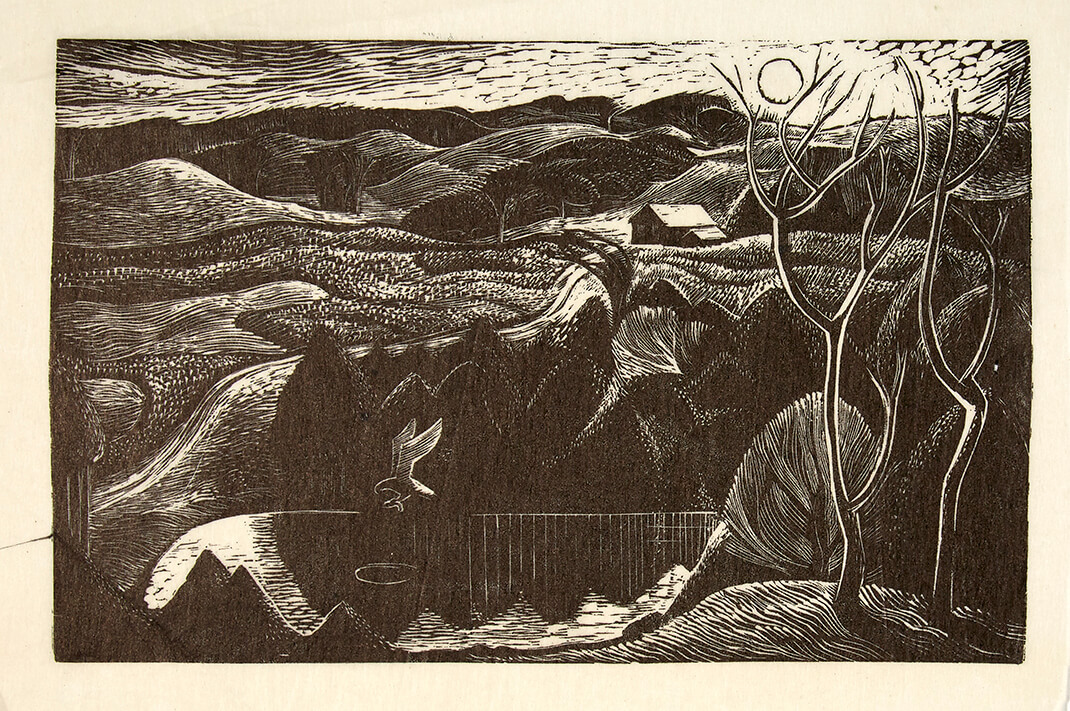
The Road to Dingle School 1959
wood engraving on paper , Promised gift, 2018
from Art Gallery of Hamilton exhibition Rosemary Kilbourn: A SIngular Place
The Next Best Step
In early 2023 the Friends met again to discuss whether to move forward, with the possibility of going into hibernation until the situation around the dam and the TRCA’s commitment to managing heritage assets became clearer. While the appearance of a donor with a substantial amount of money would of course be a timely intervention, it’s not clear whether funds alone would secure the future of the Schoolhouse.
At this point in the group’s history, something magical happened as we all realised we had become friends bound together by this common vision. While occupying the schoolhouse itself could not yet form an active part of our vision, the building itself in its genius loci and within the beautiful landscape of the Caledon Hills was ours to celebrate as we chose to. Indeed, this constellation of relationships that had grown and brightened from Rosemary onwards, in communion with the schoolhouse and the land was still something real and needed to continue to be nourished with gratitude and love.
The ideas about how to keep the Friends of The Dingle Schoolhouse and its community alive then came thick and fast: En Plan Air art and writing workshops, walking guides, mapping software and podcasts were just a few. Until the schoolhouse was ready, its Friends would be building its community through relationship building; each step is the next best thing we can do.
Footnotes
- A two-part article written by Kira Dorward appeared in the Caledon Citizen on August 23 2019 and and August 30 2019. I draw on these useful articles for much of the background in this blog.


 James T Jones
Leave a comment