
I am pleased to say I had a good few ideas for this week’s short blog (again Thursday not Wednesday, sorry), but after attending an excellent webinar from the University of Guelph’s History Roundtable yesterday, i had to get a few lines down about it.
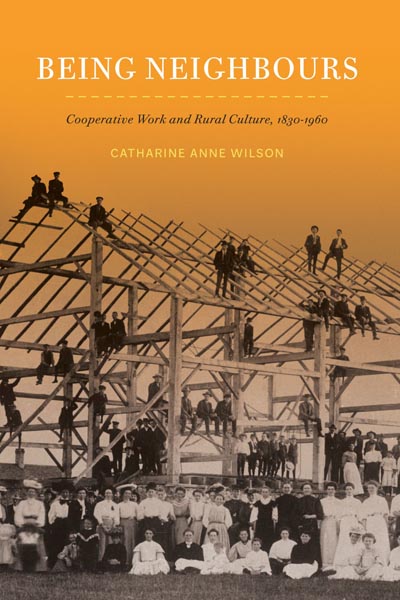
As a researcher who often looks backwards to go forwards, I was very excited to attend the launch of Dr Catherine Wilson’s book “Being Neighbours: Cooperative Work and Rural Culture 1830-1960″. Dr Wilson has based her study on the Rural Diaries Archive at Guelph and gave us a tantalising glimpse of the book’s contents at the launch. My own diary from yesterday would record that I had hoped to attend in person but was frustrated by the start of the 15cm snowfall that made travel unadvisable!
While at first disappointed not to attend in person, because the talk was about rural lives it seemed fitting to be sat round the fire in the living room at Mount Wolfe Farm with Farmer Sarah and her mum Sheilagh. We were entranced for over an hour with first Dr Wilson and then the a film with old photos of barn raisings and threshing Bees. As people who farm ourselves, we felt an intimate connection to these people and the lives they led. Even if they were different in so many ways, the core problem they had to solve was the same: how to get work done, stay connected and earn a living.
The solution Dr Wilson explores in her book is the ‘Bee’ or working bee, so called because those involved were as busy as the proverbial bee. Bees were collective labour focused to achieve a task on a community member’s land, for instance barn raising, threshing, quilting (The Whole Village, our neighbours here in the Caledon Hills, still have regular Bees).
What came across clearly from the talk is the importance of the bees in social cohesion, and sometimes as the mechanism of restorative or retributive justice. The diaries clearly record an informal tallying of reciprocal obligations- tasks completed and tasks owing- in order to maintain equity. If a neighbour shirked on their obligations, they found that they could no longer draw on the collective benefits. In one case, a family member was killed on a barn raising but rather than disrupt the collective social compact, the ‘guilty’ landowner was required to compensate the bereaved with more labour, and life went on. However when a family clearly abused the system with violence and intomidation, as the infamous Black Donelly‘s did, the full force of the community was levied aupon them. The Donnellys’ ongoing feuds with local residents culminated in an attack on the family’s homestead by a vigilante mob on 4 February 1880, leaving five of the family dead and their farm burned to the ground. No one was convicted of the murders, despite two trials and a reliable eyewitness.
I’m only touching on the treasure trove of knowledge from yesterday’s talk and I am looking forward to reading the book. This research is valuable not just as a reflection on the past, but also to inform the present and future directions, particularly when we look towards sustainable solutions for the challenges we are facing in society. One solution to the problem of transitioning away from fossil fuel energy involves a shift away from high energy, high technology livelihoods “back” to more land-based livelihoods where people once again do the jobs that we can no longer afford energy-expensive machines to carry out. It sounds frightening, but what social benefits might acrue from this transition? The interdependent, communitarian organization of lives represented by the Bee is lacking in our modern society, largely because of the increasing mechanisation and ‘virtualisation’ of our work spaces.
Their is much ongoing debate about the structure of “post-growth’ societies and what we need to do to get us there. In this “Doomer Optimism” podcast I listened to on my journey to work this week, you can hear a debate between proponents of at least two of the sides in this argument1– ecosocialism and a more decentralised form of capitalism. One of the things that strikes me about the Bees is that it is a very localised solution to the problems of a small community, a bottom-up approach to organising. Its not perfect, but it does emerge from the narratives of the people involved and the place where they live, which I think is a good place to start.
Here is the link to Dr Wilson’s presentation (I will post update when available). If you are interested in these rural diaries, its worth knowing that you can volunteer to transcribe diaries with the Rural Diaries Archive
Footnotes
- DO107 with The Last Farm (@TheLastFarm) and Gregory Landua (@gregory_landua) with Jason Synder (@cognazor)
 James T Jones
Leave a comment