Many years ago in my early 20s when I first started walking in the landscapes UK just for the sheer pleasure of it, I might find a track along the edge of a field, or between two fields, bordered on both or either side by a hedgerow. I would walk along side it, comprehending the totality of its as a barrier, a fence, a guide for the direction of my walk. Maybe I would also sense the hedgerow as a home when a blackbird might send up a harsh alarm call or pausing to smell the particularly aromatic delight and visual display of hawthorn in bloom. But in all probability, to spin a much used metaphor, I couldn’t really see the trees for the wood.
It would be another ten years before the endangered hazel dormouse led me into the mysteries of the ecology of traditional hedgerows and how the hedgerow was merely a pattern emerging from the plants and the animals that live in and around it. If you were looking closely, the plants could tell you about how this particular pattern, in this singular location, had come to be. You might see the tell-tale sign in an old hedge of past management- new growth arising from a stem at 45 degrees, indicating the hedge had been ‘layed’ at some point in its life. The hedgerow could tell its own fascinating story.
Now, as a practitioner of what my friend and mentor Ron Donaldson (@ron.donaldson) calls Narrative Ecology, I know that if you care to spend the time to look and listen, stories emerge from the patterning of the world that you might otherwise take for granted. Giving attention to stories reveals a complexity that might be missed, intent as we all are on reducing our lives to simpler rules for making choices between competing demands.
Last week I stared a Narrative Basecamp course with TheCynefinCo. Its an introduction to the importance of narrative research, theory and practice and using their Sensemaker platform for story collection and analysis which I hope will form part of my PhD research. During the course we are encouraged to share our observations about stories and narratives through the Sensemaker App, but I also thought I would share my observation on this blog.
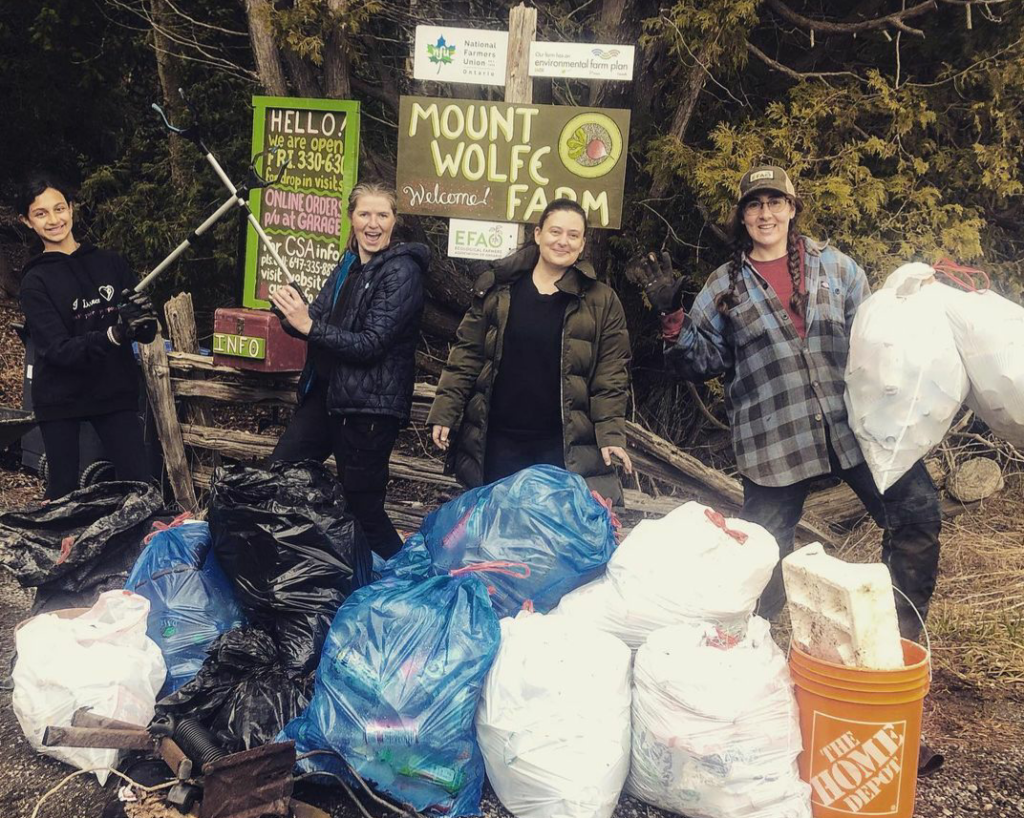
Following the first session last week I strolled down to Old Church Road to join Sarah, who was helping Amy Darrell (@onelittlefurther) with her Garbage to Gear fundraiser. Amy collects rubbish from the roads around Caledon and invites people to join or sponsor her. Donations will help to fund an outdoor gear lending library so people are more able to access the outdoors for their own well-being and to foster a connection to nature. With Amy were Lu from @EcoCaledon, our own Debbe Crandall and Yamuna our wonderful egg-collecting neighbour. In total “we” (I wasn’t there for long!) collected 104 lbs of rubbish over 500m.
I thought about the constellation of stories that this activity represented. The two most obvious were the stories in other peoples’ lives that give them permission to throw rubbish from passing cars and the stories that made us feel we had a responsibility- to each other, to the environment-to clean up rubbish that was not our own. There were stories, too, in the rubbish we picked up, that spoke to a narrative of consumerism, capitalism, and health and of an economy that doesn’t think enough about waste. Fast food, plastic bottles, cans, a can of paint, some sacks of concrete, an old chair. I’m sure you could think of many other stories once you find one- they have a habit of being connected one to another like plants in a hedgerow.
Our end of Mount Wolfe Road looked so much better afterwards. I don’t think any of us, least of all Amy, were in any doubt that we had addressed the root of the problem. Those lie in the stories I’ve mentioned above. Yet in linking the rubbish to a larger narrative about connection to nature, Amy’s fundraising asks us to look at our relationship with the natural world- what is the story we have about nature and our responsibilities for nurturing it? Modernity’s current approach seems little more than as a resource to fulfill our own insatiable desires and a rubbish bin to discard our unending waste.
Sometime if you tell a story enough you start to notice inconsistencies too. Nature is a one-word story that places boundaries around things that doesn’t include us. Why do you think we do that?

 James T Jones
Leave a comment