I let my intuition explore connections between shifts in seasonal farming patterns, Graber and Wengrow’s ‘The Dawn of Everything’, Tai Chi and Panarchy, and the importance of metaphors, stories and narratives in understanding and action.
Earlier today Sarah and I met by the Forge (Wayland’s Other Smithy) looking for a space to place the new storage box John had fashioned for the steel and tools so they don’t have to take up space in the Drive Shed. Sarah was busy with pack-ups for the day’s CSA pick-up and I was taking a walk between stints on a scoping essay for my PhD Comps exam. With a site selected, as we moved to return to our respective tasks, I reminded Sarah that I was due at Whole Village this afternoon for a tour with my PhD Supervisor and another colleague.

“What time will you be back’” asked Sarah “to do your delivery route?”
Everyone has those moments when you get a cold feeling that is a signal your expectations of the future are not in synch with someone else.
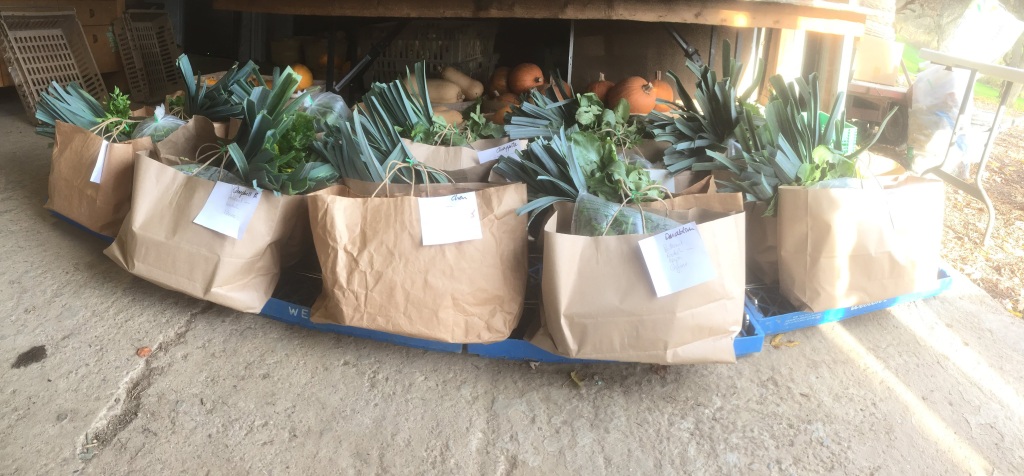
“Its the first week of winter pack-up?” continued Sarah. Pack-up for pick-up. Of course the view that greeted me in the drive shed earlier wasn’t the usual lay-out of tables for the Pick-Up which happens every Friday at the Community Supported Agriculture business that is Mount Wolfe Farm. Members arrive on site between 3:00 and 6:30pm to collect their ecologically grown vegetables from tables laden market-style with seasonal produce and custom orders of locally-sourced foodstuffs.
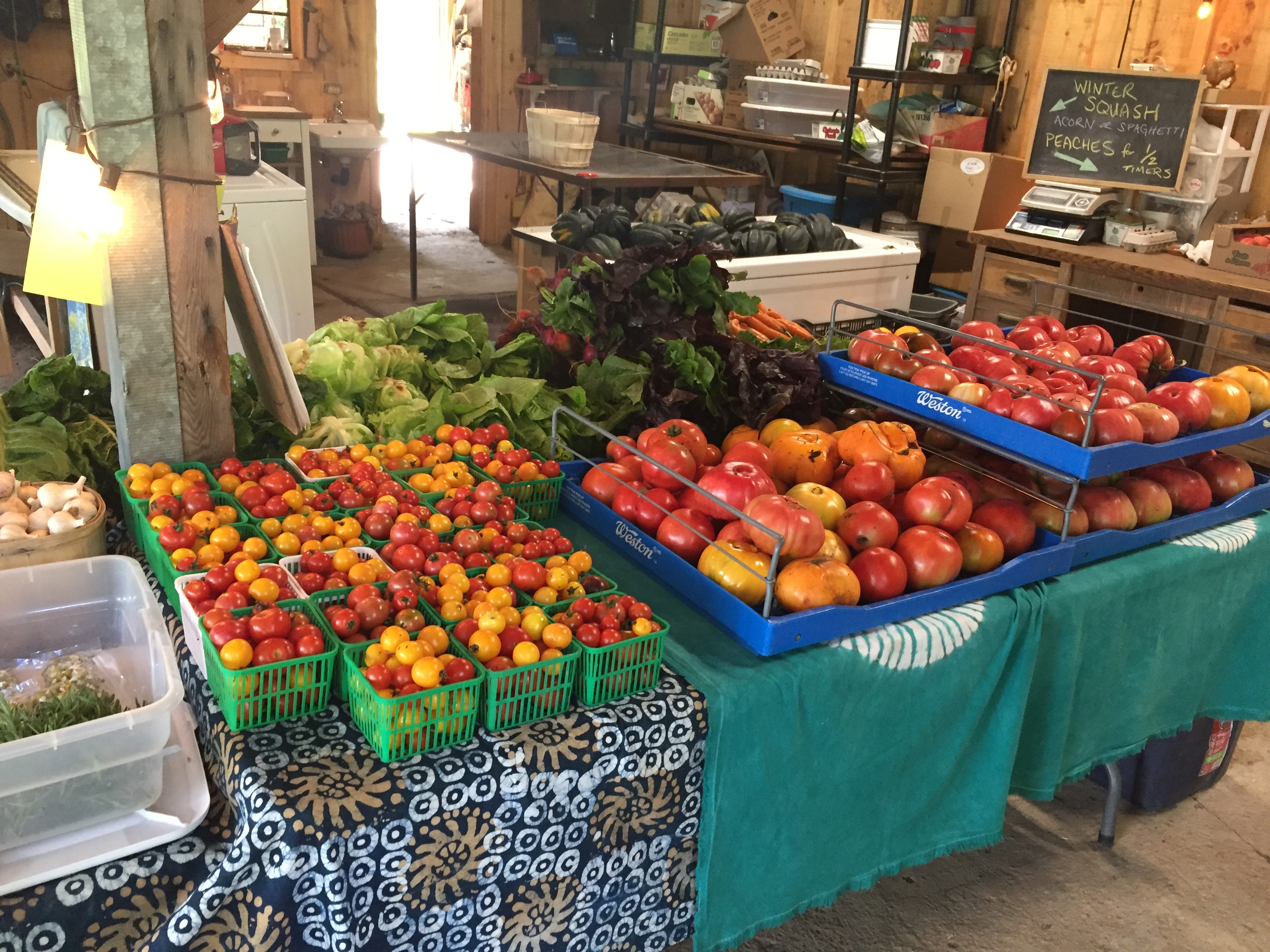
CSA Pick-up ‘Market-style’ (Summer) 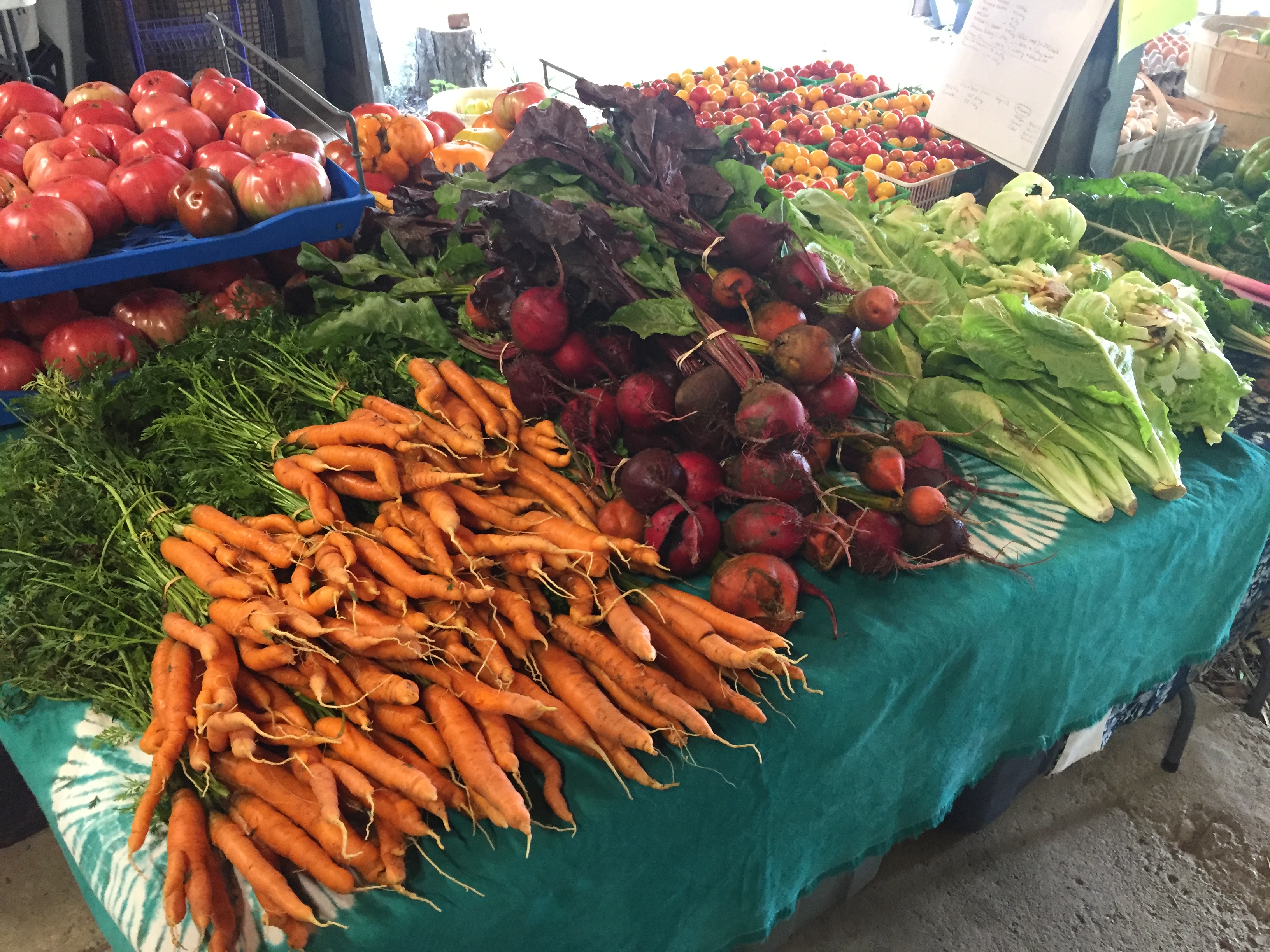
CSA Pick-up ‘Market-style’ (Summer) 
Winter shares ready for delivery
However last winter, with COVID restrictions in full place and winter conditions testing access to the farm up the steep driveway , we pivoted to delivering shares to members at their own homes. I enjoyed this immensely, it reminded me of by-gone days in the early 1990s when I was a Domino’s Pizza-Deliverer on a Honda Cub motorcycle in North London. I got to know the members on my route and they got to know my face a bit more than when I’m at Pick-Up when Sarah and her family are centre-stage while I might be carving a spoon, preparing the ritual tea service for the crew, or minding Magpie.
We did celebrate our last CSA pick-up two weeks ago, and I knew we now had shifted to once-a-fortnight that characterizes the winter months on the Farm. Somehow though the message that we were going to delivery straight off the bat had not got to me; I should obviously attend more farm meetings!
As it turned out there were more than enough people around to cover the routes, but it also transpired that in fact I had got the wrong week for the Whole Village visit, which is fact next Friday. My head is in an interesting space right now, partly becasue it has to be. The powers of creativity needed to write an essay with some originality requires a non-rational component that is difficult to explain, but it also was responsible for the connections that came next as Sarah and I sat down for lunch.
As I develop as a narrative ecologist (sensu Ron Donaldson), I’m looking out for narratives, stories or metaphors that are useful in shifting the patterns of ways we make sense of and interact with our world. I’ll address this in more detail in future posts (its broadly the topic of my PhD). I was reflecting on this seasonal shift between CSA pick up to delivery as an adaptive response to shifting variables in demand and the external climate. The switch was initiated by the rapidly deteriorating public health crises posed by COVID, but maintained because the pandemic increased numbers of members and meant that the farm infrastructure couldn’t support an indoor market-style pick up the way it had in years previous.
I was also reminded of one of the thrusts of The Dawn of Everything, the new book by David Graeber and David Wengrow. I confess the book is in my growing ‘To Read’ pile, so the connection comes from a reading of an article at Eurozine.com: How To Change The Course of Human History. The article takes a shot at the popular narrative of the shift from hunter-gatherer societies living in small, highly-egalitarian bands (Rosseau’s “State of Nature”) to be replaced at the advent of agriculture by ever-growing, highly-concentrated populations living in hierarchical dominance structures. However Graeber and Wengrow present compelling archaeological and anthropological evidence that this narrative is wrong: that social order was never as fixed or immutable as suggested. Anthropologists speak of societies with two structures as possessing a “double morphology”:
Marcel Mauss, writing in the early twentieth century, observed that the circumpolar Inuit, ‘and likewise many other societies . . . have two social structures, one in summer and one in winter, and that in parallel they have two systems of law and religion’
Graeber, D., & Wengrow, D. (2018). How to change the course of world history. Eurozine, March, 1–16. p32 https://www.eurozine.com/change-course-human-history/
I’ll be looking out for just how this ‘double morphology’ in our particular style of Community Supported Agriculture Program CSA pick-up leads to different patterns in our lifeways.
As I was sharing these thoughts with Sarah thoughts and sensations from earlier that day resurfaced. I had emerged from behind my desk and out into the November sunshine, and before my conversation with Sarah , I threw sticks for Magpie. This led me to a spot near the winter site for the mobile chicken coop; a flat piece of land with the sun streaming dreamily through the trees. I straightened up and much to Magpie’s dismay stopped throwing sticks and instead practiced my limited range of Tai-Chi moves. In case you have been wondering, this is where the Grasping The Sparrow’s Tail (Lǎn Qùe Wěi) comes in. Its the second posture in the 37 Yang Style short form. I know the first ten of Yang Style but I’m terrible at committing to the practice. I can link the ten moves together so I make a continuous loop, and this morning in that playful sunlight I managed to put away thoughts as best I could and I experienced something of a continuous flow which felt wonderfully relaxing.
What seems to connect these seasonal shifts to Tai-Chi was the patterns my movements made in space: almost a figure of-eight loop around my core (dan tian). But because my last move was a step to the side and forward from my initial position I found myself travelling slowly toward the tree like a drunken bishop in a game of chess. Anyone familiar with C.S. ‘Buzz’ Holling‘s theory of adaptation and resilience will recognize a pattern reminiscent to the cycles of Panarchy.

Jim’s Tai-Chi moves 
Figure (above)- Panarchy connections. Linked adaptive cycles at multiple scales. See https://www.resalliance.org/panarchy
“So what?” you might say and I might reply “What indeed!” because I honestly don’t know, beyond an intuition that these metaphors- the seasonal shifting of the CSA, the Panarchy, Tai-Chi and Graeber and Wengrow’ s new narrative of human history are important because they provide pictures of the world as something that flows and changes and invites us along to change our perception and subsequently our actions to fully participate with it.
There is a tension here between the importance of place in our lives as a foundational anchor not only to individual lifeways but to communities over time that writers like Wendell Berry, Gary Snyder and more recently Paul Kingsnorth extoll; and the need for movement and, dare I say the word…..growth. But seasonal patterns of movement and change are ingrained in our being and should be celebrated because they embrace a dialectic between motion and stillness, and bring a sense of periodic renewal that is more holistic and resilient than linear growth.
With COP26 looking much like another talking shop with very-little in the way of change and instead much in the way of carbon emissions, it seems likely that this ability to be adaptive, perhaps in a seasonal; pattern will make business and communities more resilient.
In a shift to a more sustainable world policies and plans to create external structures for people to try and fit themselves in to may be useful in some contexts. However I maintain that sustainability is a crises of perception (more about that anon). This crises is a calling to refocus our lives to the complexity and holism of life, and to work with itts essential ingredients including impermanence and flow. Here we need to explore metaphors, stories and narratives like the seasonal shifts in the Mount Wolfe Farm CSA, that surface patterns that work in a given context. We let the evolutionary power of culture do the rest. Its not a process that happens quickly-although it could; but if we ever hope to be part of societies that emerge organically and embrace the complexity of life, its a critical process.
 James T Jones
Leave a comment