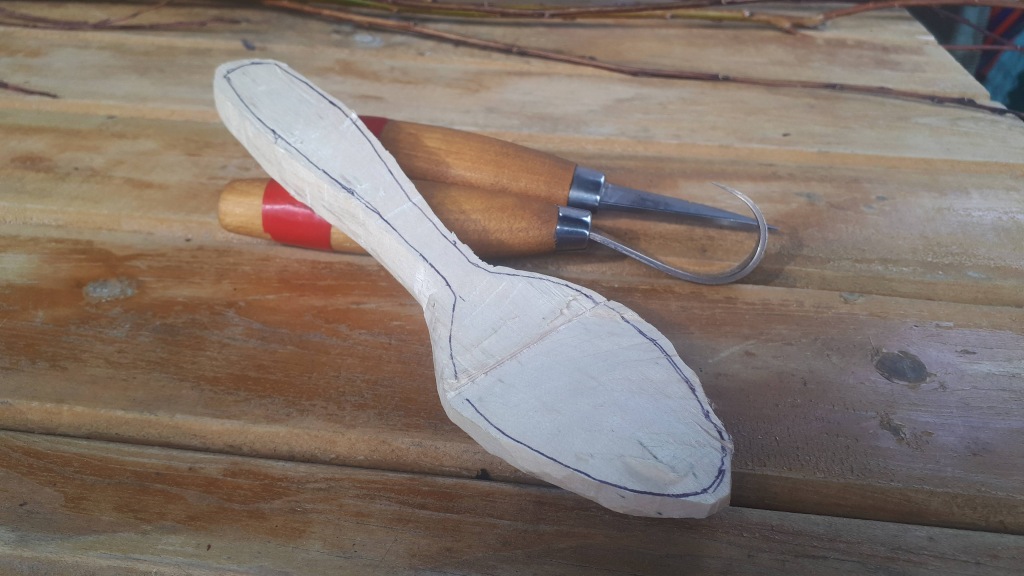
In which I carve spoons , listen to podcasts and take a brief, meandering walk through post-pandemic society via ‘”doomer optimisim”, situated cognition, Cynefin, beauty and the on-going wonderful experiment at Mount Wolfe Farm.
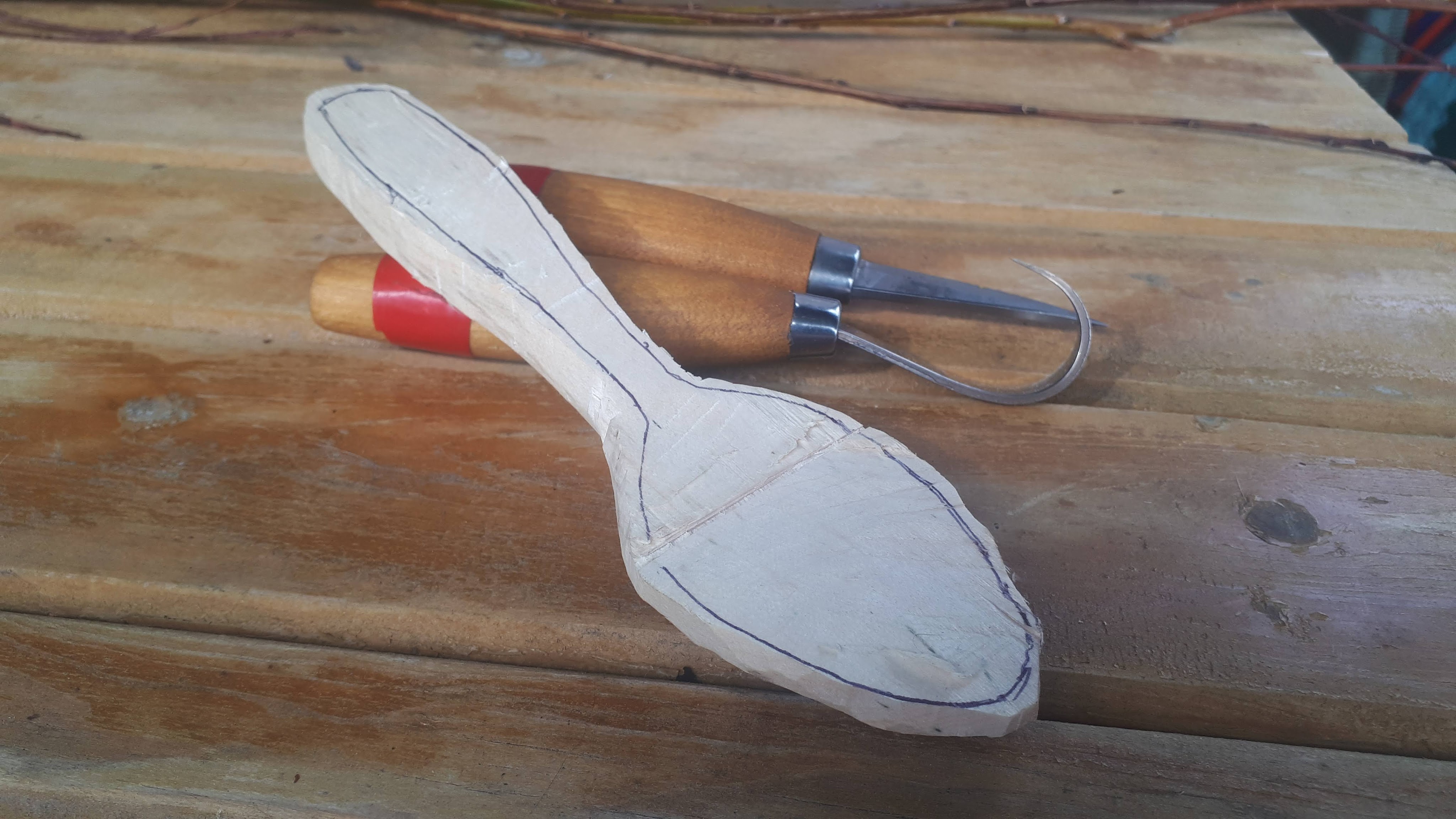
I spent a lovely few hours yesterday making carving billets from a bit of sugar maple and roughing out an eating spoon. Its such a joy to be in Poppa Crandall’s old workshop surrounded by old tools and work a piece of sugar maple cut from the North Woods on a shave horse I built. Its been a while since I’ve made a spoon though: because of the COVID pandemic the rural skills workshops in spooncarving, blacksmithing, basket weaving and hedgelaying we have put on here at Mount Wolfe Farm as the Ontario Rural Skills Network (ORSN) have been in hiatus. Since October of 2020 I have also been a full-time student again and engaged in learning and teaching (as an assistant) at the University of Waterloo.
Music has always been my favourite accompaniment to carving. You can listen to my predictably folksy ‘Spoon’ Playlist on Spotify if you like. But whenever my fiancée Sarah isn’t farming she paints and always listens to podcasts, so i thought it might be time to develop a habitat!
I had been pleased to discover The Jim Rutt Show as a consequence of taking a Sante Fe Institute Complexity Explorer MOOC and then hitting up two interviews with Tyson Yunkaporta after the release of Sand Talk. So when i heard one of my Twitter follows was on the show I made sure to tune in.
I recently became aware of Ashley Colby from her posts on Twitter as Rizoma Field School (@RizomaFieldSchool), which is the her base in Uruguay set up to consider resilient paths toward the future. In her conversation with Jim Rutt Ashley outlines themes from her work as an environmental sociologist exploring the diverse and creative ways in which people are forming new social worlds in resistance to the failures of late capitalism and resultant climate disasters. The conversation covers ideas about bottom-up ‘unself-conscious’ change; the value of spontaneous ‘messy’ solutions rather than engineering; networked social capital and re-enchantment
Many aspects of the conversation are close to our hearts here as a CSA farm, fledgling skills hub and would-be forest school at the heart of a community; and also with themes I am exploring in my own work and studies as a PhD student of Professor Steve Quilley who has written extensively about the post-growth landscape and about the idea of livelihood as a survival unit between market and state (Quilley and Zywert 2019, see also Navigators of The Anthropocene). An interesting aspect in our community here in Caledon is its wealth; will this cushion the impact of social collapse or do we have further to fall when the it comes?
Some ideas that really stuck with me from this podcast are Morris Berman’s Dual Process Theory and the shadow structures that emerge when one system fails and another emerges. I am reminded of basins of attraction from dynamical systems theory and of Stuart Kauffman’s ‘adjacent possible’.
My second podcast was an interview with another recent follow on Twitter, Jason Snyder from Alex Kaschuta’s Subversive podcast. Jason is a Professor (I think!) of regenerative / bioregional food systems at Appalachian State University. His talk with Alex ranged around homesteading, cosmopolitan localism, permaculture, and homeschooling. I think one of the most interesting aspects of the conversation was the mention of situated cognition the theory that knowing cannot be separated from doing. I don’t know a lot about this but I feel there might be synergies with the Csíkszentmihályii theories of flow which have inspired me in developing the Ontario Rural Skills Network as a place for hands-on learning and reconnection to the land.
And lo! Thanks to the power of Twitter I was updated by Ashley that she and Jason have also been talking and have had a conversation together on Doomer Optimism on The Stoa . Through which I discovered The Stoa so thanks for that Ashley. My blog has always been about connections and they seem to be flowing thick and fast these days. As Jim Rutt mentions in the podcast there are a lot of people working on alternatives to the current system which he calls ‘Game B’ or ‘Game-B adjacent’, a new ‘operating system for humanity going forward. Its good to think Mount Wolfe Farm and ORSN might recognise themselves in this community of new social entrepreneurs and ‘doomer optimists.’
Picking up on one of Ashley’s points about spontaneous solutions and a compassionate attitude towards mess. I’m sure I will write more about this but I know I am not alone with a certain paralysis of thought and movement faced with trying to understand what I personally need to do and collectively what we can do to in facing up to my our responsibility for the unfolding synchronous failure of the modern world. But its clear that doing something is better than nothing, and in complex scenarios small ‘safe-to-fail’ messy experiments in alternative living are exactly what is called for.
This blog- a small messy experiment from the outset- in future will be focusing on the messy experiments happening all around me, and the stories that lie there in. Stories are the way humans understand patterns, and in a world where the patterns are shifting, we need to watch the stories that are emerging as a prefiguration of future resilient social-ecological systems and institutions, the carving of the adjacent possible.
In January 2021 I took the Cynefin BaseCamp course. Cynefin isn’t a country, although it could be: Cynefin (Ky-nev-in) is a Welsh word that translates to ‘place of our multiple belongings’ . The framework was developed by Dave Snowden and offers three primary decision-making contexts or “domains”—ordered (Clear. Complicated), complex, and chaotic, —that help to perceive situations and make sense of individual and group behavior. I’ll talk about this more in future posts.

Cynefin Framework 2020 from Snowden and Friends 2021 
Cynefin 3D by Martin Berg https://www.vige.se/blog/2020/6/20/cynefinvige
When you arrive in a new country as I did back in 2018, and as we are all doing now as we emerge from this Pandemic, you cross a threshold into a new domain. I was lucky to be coming to Canada which is like the UK but without roundabouts, so very familiar and i had what are referred to in Cynefin as ‘enabling constraints’ : I was coming into a job at the University of Waterloo; I had a place to live, the wonderful Mount Wolfe Farm where my fiancee Sarah and her family live and work. So it didn’t feel like chaos, but it was far from clear. There was a lot of creative destruction happening as I left behind a career as Living Landscapes manager at Surrey Wildlife Trust, but it also felt like an open chasm of possibility…
In Cynefin we make sense of complex situations by a probe-sense-respond cycle and develop a practice from what emerges. If you are too rigid in setting goals and directions and timelines, you can quickly find yourself in chaos because you aren’t working in a space where the constraints are fixed and the relationship between cause and affect is simple.
This probe-sense-respond space is so important to guide us in moving in to the future in a world of uncertainties. Keats described this ability to live with uncertainties as negative capability, and concluded that the focus- for Poets at least- was Beauty above all else.

So perhaps as we go forward with these small, local experiments in living to find a new operating systems for H. sapiens 2.0, we might let beauty be our guide. In Brading Sweetgrass, in its entirety a work of beauty, Robin Wall Kimmerer asks “Why are Asters and Goldenrods beautiful together? ” In humans, it’s the reciprocal colour relationship that overstimulates the cone cells in our eyes. For bees, the striking contrast is a flag which which means growing together increases the individual chance of pollination . For Kimmerer herself this reciprocal relationship is representative of her longing to understand the ”architecture of relationships, of connections” (Kimmerer 2013 p46).
Kimmerer also writes of Indigenous scholar Greg Cajete; we understand a thing only when we understand it with all four aspects of our being: mind body, emotion and spirit.: “It is the whole human being who finds the beautiful path” (Kimmerer 2013 p47).
 James T Jones
Leave a comment