
‘The explorer who will not come back or send back his ships to tell his tale is not an explorer, only an adventurer; and his sons are born in exile.’”
Ursula K. Le Guin, The Dispossessed 1974
In anthropology, liminality (from the Latin word līmen, meaning “a threshold”) is the quality of ambiguity or disorientation that occurs in the middle stage of a rite of passage, when participants no longer hold their pre-ritual status but have not yet begun the transition to the status they will hold when the rite is complete. During a rite’s liminal stage, participants “stand at the threshold” between their previous way of structuring their identity, time, or community, and a new way, which completing the rite establishes.
https://en.wikipedia.org/wiki/Liminality
Where do you start when you set off exploring? When the mood takes you, perhaps. Rise up from your seat, open the door and, without a hat or coat set your foot on the path. Or maybe you wait for a significant event. Your eleventy-first birthday perhaps?
I find Beltane (May 1st) is always a good place to start. We celebrate Winter and Summer Solstices at Mount Wolfe Farm with those of our community who care to join us for food and storytelling and Gratefulness ( I prefer this word to ‘Thanksgiving’ which has religious and colonial overtones). The other festivals of the Wheel of the Year we meet as they meet us. I’m always there in some way, marking the crossing over of the Threshold.
The celebrations that mark the eight-spoked Wheel are thresholds (limen), or doorsteps if you like, and in Celtic myth where I have looked to all my adult life for inspiration, spiritual guidance, stories and sense of oneness, each festival is marked by a breakdown of the barriers between worlds so that the gods and ancestors may be greeted in a world where laws of time and space no longer rule.
So it was that this Beltane I marked not so much by a physical action, a stepping out on the path, but more a heightened awareness as we crossed the threshold. I think I’m now writing this because, like so many synapses firing in a chain of cognition, moments have fused together to mark out the past few days at the beginning of this month where a significant change in my perception occurred. How significant still remains to be see
First, I should say, we have context.
We are travelling through perhaps the most liminal space any of us can remember. Locked in to our homes, wondering when COVID-19 will have finished waging its viral war against us, many of us are using the time to ask questions about how we got here, whether we are happy with how life is working right now, and importantly where do we want to go from here. That most final of thresholds is so much more present for many of us, especially the old and immune-suppressed.
I will also confess to having my creative imagination filled recently with wonderful imagery– if a little violent in the latter case- from the minds of creative geniuses: Ursula K. Le Guin and Noah Hawley. LeGuin needs no introduction, although I will say I am alarmed I haven’t discovered her before now. I pulled The Compass Rose off the bookshelf where it was on lone but as yet unread along with other titles from Jeff our Farm Hand and Skateboard King. Noah Hawley is the writer of all three (currently) series of Fargo, the TV series adapted from the brilliant Coen Brothers Movie. It is storytelling at its finest, but also reminds me of the sublime (there’s that liminal space again) Twin Peaks from David Lynch, which managed to be both incredibly homely and disturbingly dark both at the same time. I can still hear the wind through the pines in my day dreams and it chills me to the bone. In one scene in Series 3 of Fargo, we indeed have the actor Ray Wise who was magnificent as Leland Palmer in Twin Peaks, now playing the mysterious Paul Marrane , The Wandering Jew reimagined, and meeting the parolee and card queen Nicki Swango in a bowling alley in the middle of nowhere, bestowing on her a mission of (divine?) justice. This is as Lynchian as you get, but I also love the reference to the ‘bowling movie’ The Big Lebowski, another Coen Classic.
So the scene is set. COVID-19 has given me the opportunity to do something I have always wanted to do: I have a storytelling group. On Friday nights at 7pm I host a Zoom session as part of my Ontario Rural Skills work. We have a small but perfectly-formed company of five at present and have shared stories both real and fictional around topics like resilience and dreams. On May 1st, I set the scene for the tellers that today was Beltane when boundaries were broken, lovers frolicked in the fields, cattle ritually purified between two fires, and the Lords of Misrule were on the hoof. I read a poem by Edward Thomas, ‘As the Teams Brass Head’, which to me has liminal aspects to it: the young lovers wintering and leaving the woods marking the space; the returning ploughman like the seasonal cycle offering wisdom; and the alternative timelines suggested by the ‘what -if?’ scenario of Thomas’s fallen comrade and the still-standing tree in which he sits. Shelagh read the Story of The Chinese Farmer here retold by by Alan Watts which speaks also of another quality of interest to me and in the same camp as liminality: that nothing is inherently good or evil, just that our interpretation makes it so.
On Saturday morning I found myself again on Zoom, this time speaking to new friends in England and India and Ontario about a new project I am becoming delightfully entangled with called The Midnight Kitchen, the brainchild of doctor, spoon-carver and fellow lover-of-stories Jane Myat who created a liminal space at the Caversham Group Practice in the UK called The Listening Space, a patients’ community garden in the central courtyard of the Caversham Group Practice.
“It’s for anyone who’d like to come and potter around a garden in a relaxed and friendly environment. You don’t have to know about gardening and you don’t have to feel pressured about making conversation. The garden is meant to be like an imaginary village hall ……, away from the stresses and strains of everyday life, where we grow flowers and food that is shared; and where we hold seasonal celebratory gatherings. It’s a gentle way to come together as a community: a base to connect with people in a simple way.”
The Midnight Kitchen will be another place for communal sharing of food and stories, through recipes and on-line dinner-parties and picnics, but this time in cyber-space. This pandemic has made many of us more familiar and comfortable with crossing the threshold into a life played out over the web vai technology like Zoom, and even though we are craving physical contact its hard to imagine us going all the way back. I will be hosting a picnic from the farm by that most liminal space, the hedgerow. Why the Midnight Kitchen though? Its a magic time, It’s the Witching Hour, when for a few moments either side, the rules don’t apply or are made to be broken. Its also the time when people are most in need of companionship and succour, or maybe just a naughty tasty snack! It is also not lost on us that Midnight is also a liminal space, a space inbetween days. Have you ever sat and watched the clock reach 12 midnight and in a breathless moment wonder whether it whether the second hand will make it through the Twin Pillars of the Hour and Minute that lock yesterday from tomorrow.
Lastly, for now at least, Sarah spots a weasel by the hen house. In Britain, a weasel (Mustela nivalis) is a weasel but in Ontario, it’s a least weasel, to distinguish it from the short-tailed weasel or ermine Mustela erminea (a Stoat) and the long tailed weasel Mustela frenata which is a native of the Americas. Sheilagh thought it unusual to see a weasel in the day when they are more active at twilight, although in fact small Mustelids ( or Mustelidae, the weasel family) are most commonly nocturnal. One of my favourite words is used in biology to describe animals of the twilight hours: crepuscular. The etymology of this word is fascinating.
“In figurative use, “dim, indistinct,” is attested from 1660s; literal use, “pertaining to or resembling twilight,” from 1755, from Latin crepusculum “twilight, dusk,” related to creper “obscure, uncertain,” from Proto-Italic *krepos “twilight,” which is of uncertain origin. It is not certain whether “twilight” or “obscure” was the original sense; de Vaan writes, “there is no known root of the form *krep- from which the extant meanings can be derived.” Especially of evening twilight, but 17c.-18c. also “like morning twilight” as symbolic of imperfect enlightenment. In zoology, “flying or appearing at sunset,” from 1826. An older (and lovelier-sounding) adjective form was crepusculine (1540s).”
From https://www.etymonline.com/word/crepuscular
Liminal spaces-edges and boundaries and thresholds-are such interesting spaces, and I know I’m not the first to think so by any means. They have fascinated minds for at least as long as the first hominid developed his sense of other, and since we aren’t sole proprietors of ego in the evolutionary tree of life, probably long before that. I’ll be exploring limnality through the eyes of others in future blogs. But since there are also only really seven basic plots, it’s the context that curates curiosity, so mine is a personal exploration of these liminal spaces.
Here’s something about liminal spaces though: They are fuzzy places where it’s not often clear whether you are in one space or the other. When you get down to the level of grains of earth and water molecules, there is no absolute border between Cold Creek and the land it drains through. Twilight is the place of obfuscation, not day, not night. The hedgerow is edge habitat between woodland and field or between field and field. Hedgerows have been described by the ecologists Richard Forman and Jaques Baudry in their 1984 paper on hedgerows as ‘woodland edge without the woodland’.
When you look close enough at an edge it disappears and you see it for what is it: flow frozen in the moment.
Here are some of the liminal spaces currently in my life.
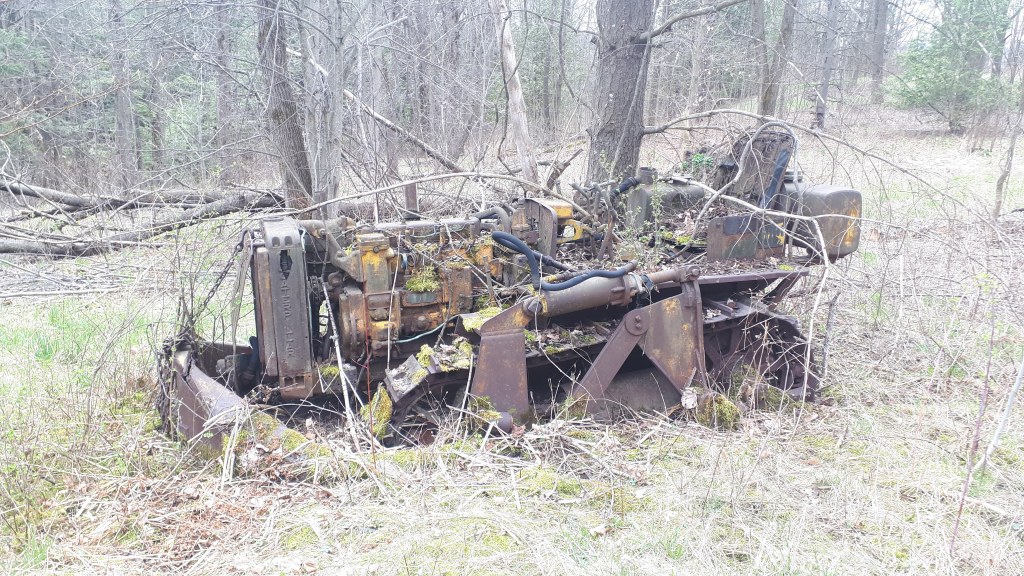
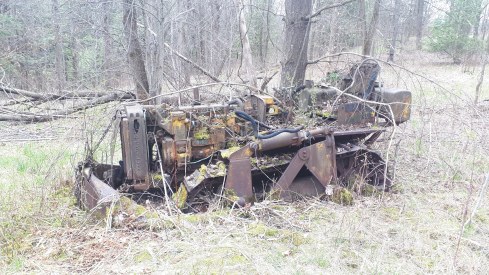
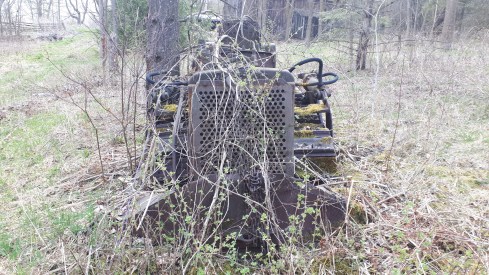
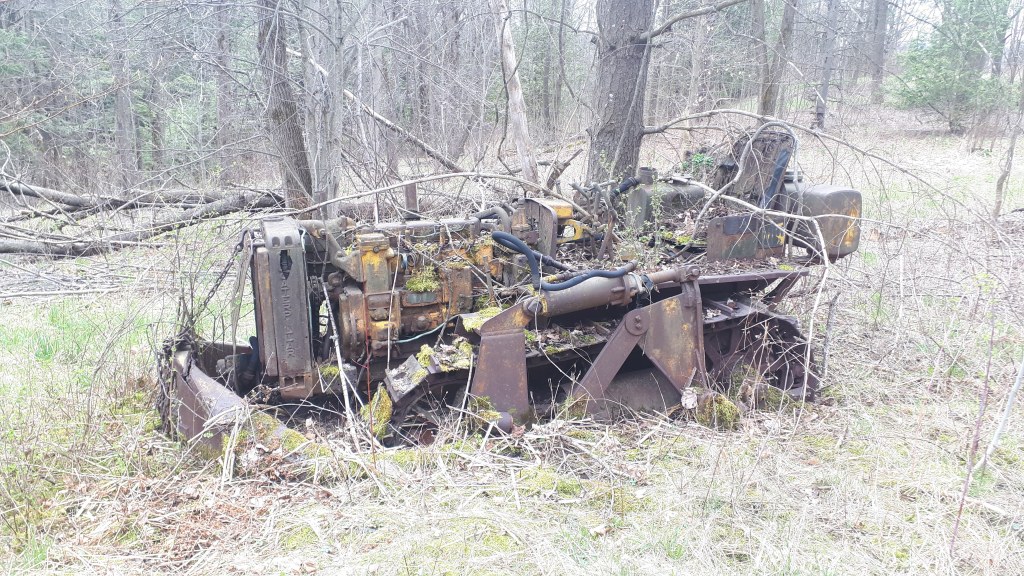
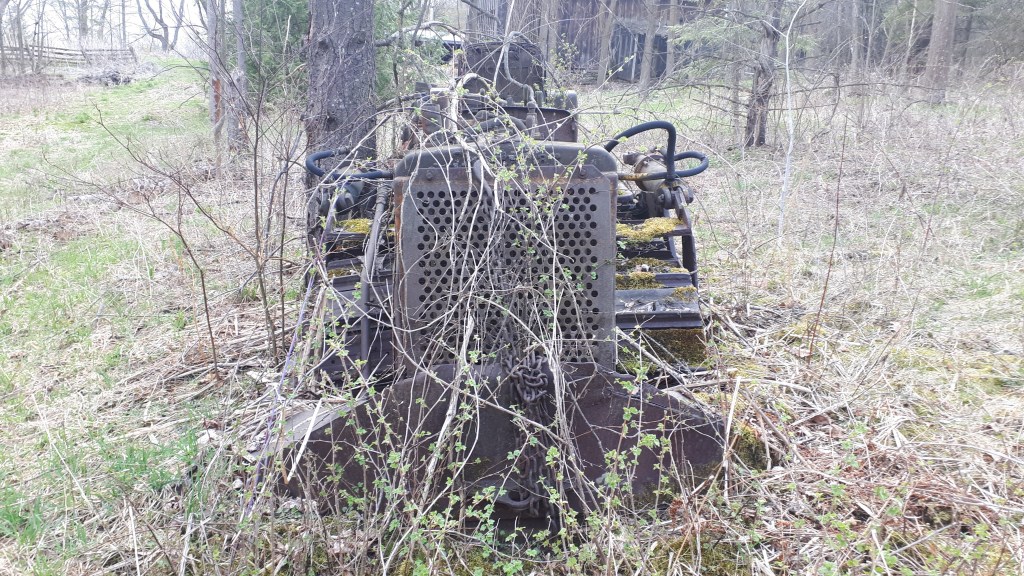
The Caterpillar
An old caterpillar tractor is being reclaimed by nature down on the way to the stone bridge. The Cat was here when Arnold and Sheilagh Crandall bought the farm in the 1960s, so it might as well have been there forever. A dinosaur, or an echo from the future of things to come…..
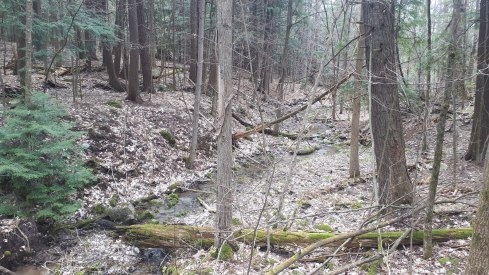
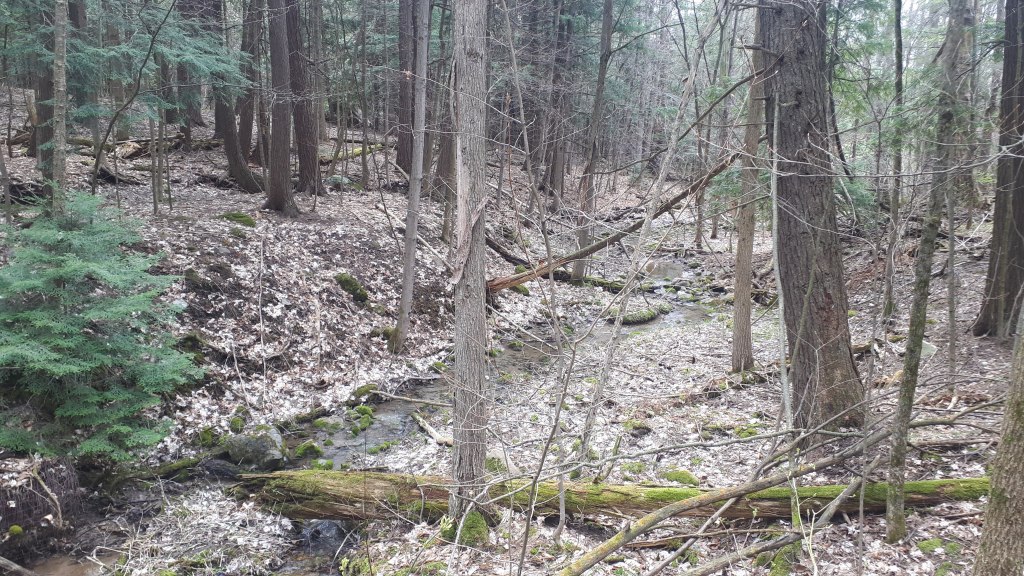
Cold Creek
A classic liminal space, where water meets earth and sky! More explorations from here forthcoming!
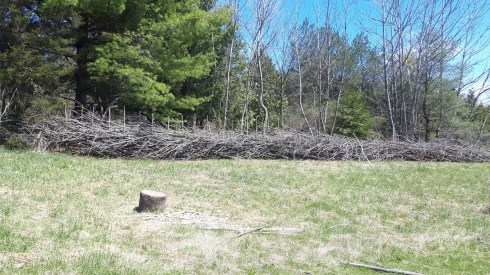
The Black Walnut Hedgerow
Sarah and I have nearly finished laying this. We do it in between everything else which is why its taken a few weeks. The black walnuts were ‘healed in’ here in two double lines by Arnold Crandall (Poppa) who loved the tree, probably while he figured out where to put them, but then never got around to doing anything with them. They make the perfect hedgerow!
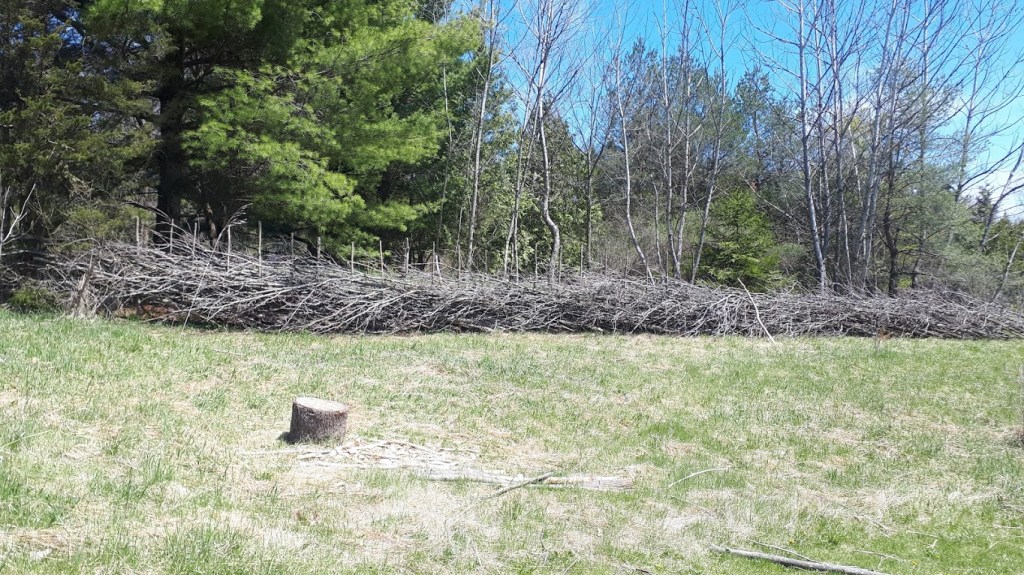
Between the Chicken Coop and the Forest
This is where the weasel lives!
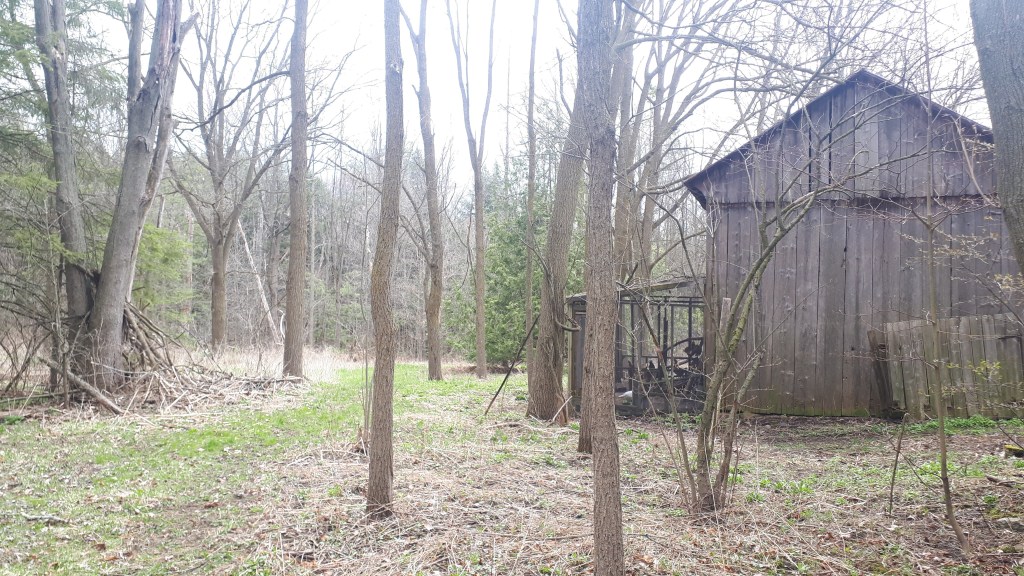
I’m sure I will find more for you to enjoy.


 James T Jones
Leave a comment