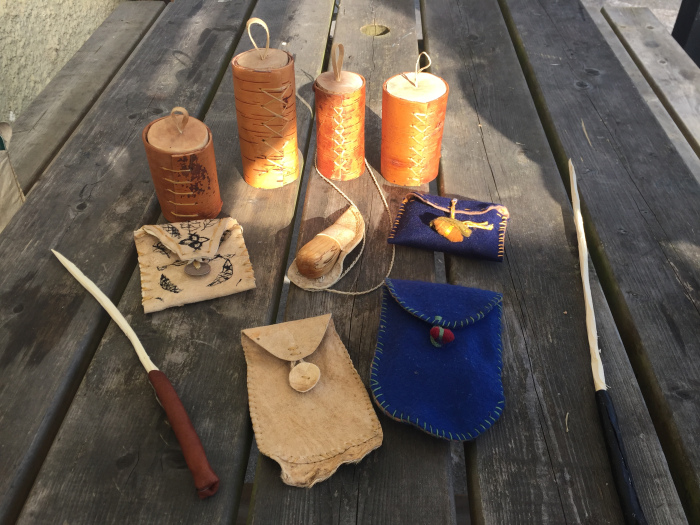
As part of my work on the Hedgelaying In Ontario’s Landscape project I have set up the Ontario Rural Skills Network (ORSN) to teach a range of traditional skills such as green wood-working (slojd), basket weaving, dry stone walking and of course hedgelaying. The idea is to use these skills to connect people to the landscape and to each other. I’ll be posting here soon about the thinking behind this approach but in the meantime Paul Kingsnorth’s wife Navjyoat has written this piece on why working with your hands- and teaching kids to do so is really important, especially in this digital age.

(With thanks to our great friend, artist and T’ai Chi teacher Caroline Ross)
Since the summer, the children and I have continued to learn about evolution and prehistory of humankind. We have spent a lot of time discovering how hand tools were made and how they were developed and refined over a long period of time. By the Upper Palaeolithic, the making of microlithic and composite tools had become a diverse set of incredibly fine, precise skills and using those tools would have required similar hand proficiency.
Using hands while still living in the trees, becoming bipedal beings and then using and making tools, have been considered important markers (and possible conveyors) of our big primate brain evolution*, enabling us to become creatively human, and importantly helped to bond us socially through this shared hand-work.
Haptic perception is the scientific name given to the human ability to experience and interpret…
View original post 811 more words
 James T Jones
Leave a comment